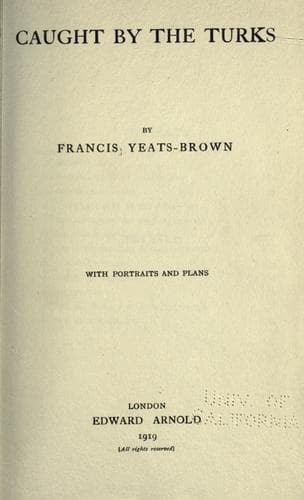
World War, 1914-1918 -- Prisoners and prisons, Turkish
I learned how to walk in a ladylike fashion, and how to powder my nose
in an engaging manner. My arms and legs had to be kept under various
restraints. A mincing gait was soon acquired, but I found sitting still
more awkward. My knees evinced an almost ineradicable tendency to cross
themselves or sprawl, while my gloved forearms, to the last, felt as
unwieldy as a baboon's. But everything I could I learned assiduously
and in dead earnest, down to managing my veil, and patting my curls
nicely in front of a looking-glass. It was so frightfully important not
to make a false step.
My only excuse for going about with Miss Whitaker at all was the
complete success of the role for which she had so skilfully prepared me.
Never for a moment was there any suspicion of my identity.
On one occasion, in the early days of my disguise, when we were
sight-seeing at Eyoub, some Turkish ladies stopped to talk to us. I
remained silent, of course, but I watched them narrowly and came to the
conclusion that they saw nothing amiss. My eyes, incidentally, were as
well painted as theirs. Now, if two charming and worldly-wise _hanoums_
cannot detect a flaw in one's form or features, it is unlikely that any
mere male could be cleverer than they.
The mere males, alas! were enthralled by my appearance. Once or twice an
embarrassing situation was narrowly averted. The road behind the Pera
Palace Hotel is dark, and we used to ascend it in fear and trembling.
But although we were followed sometimes, no one ever presumed to speak
to us.
Miss Whitaker had found me by now a delightful roof, near the house in
which I took my meals, and this place was free from all life smaller
than a rat. Here I was able to make my plans in peace, with no fear of
treachery, for, so cleverly had Miss Whitaker arranged matters, no one
knew I was not a woman.
As Mademoiselle Josephine, an eccentric German governess, who suffered
from consumption (and therefore spoke very low and huskily) I used to
pass my nights _a belle etoile_, after well-spent days in the docks or
cafes, where my plans were maturing. The stars in their courses seemed
to be on my side. No longer, as when a fretful prisoner, did I think
their quiet shining was a reminder of man's minuteness in the schemes of
God. I felt now that man could make his destiny. And when that destiny
was shaped by hands such as those that helped me, the world was a
beautiful place. Good angels were here on earth, at "our own
clay-shuttered doors." . . .
Public-domain text, read in full here on John Shaqi.
Reviews
Reviews
No reviews yet
Be the first to share your thoughts on this work.
Elsewhere in the archive
Join the Discussion
Join the discussion
Sign in to leave a comment or review.
Sign InorCreate an account