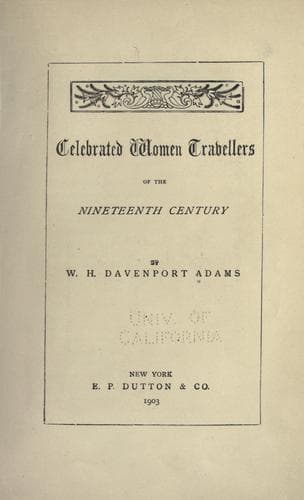
Celebrated Women Travellers of the Nineteenth Century — John Shaqi
Celebrated Women Travellers of the Nineteenth CenturyAdams, W. H. Davenport (William Henry Davenport)
History
Celebrated Women Travellers of the Nineteenth Century
Adams, W. H. Davenport (William Henry Davenport)
Women travelers -- Biography
She was still in the springtime and flush of youth, when she went on a
tour to Germany, and visited several German courts, where she excited
the same sentiments of admiration as in her own country; it was
impossible to see her without being attracted by so much intellect,
grace and amiability. Travelling enlarged her horizon: she was able to
survey, as from a watch-tower, the course of great political events, and
she found herself mixing continually with the most celebrated savants
and statesmen of the age. Her friendly relations with persons of very
diverse opinions, while enabling her to compare and contrast a great
variety of theories, did but strengthen in her "the idea and sentiment
of liberty, which can alone conduct society to its true aim." Finally,
from the Italian revolution of 1848, which awoke her warmest
sympathies, she learned to understand the fatal consequences of despotic
government, as well as the inevitable mistakes of freedom, when first
unfettered and allowed to walk alone.
At the age of twenty she was married (February, 1849), and soon
afterwards she set out for St. Petersburg, where she was recognised as
the ornament of the higher society. In the midst of her numerous
engagements, in the midst of the homage rendered to her wit and grace,
she found time to collect a mass of valuable notes on the condition and
inner life of the great Russian Empire, several provinces of which she
knew from personal observation. From St. Petersburg to Moscow, from
Odessa to Revel, her untiring activity carried her. Most social
questions are at work under an apparent calm, and offer, therefore,
subjects well worthy of careful study, especially to so grave and clear
an intellect as that of Princess Dora d'Istria, who possessed, in the
highest degree, the faculty of steady meditation amidst the movement and
the world-stir that surrounded her. The world, charmed by her personal
attractions, had no suspicion of the restlessness and activity of her
inquiring mind.
Her departure to the South brought her inquiries and investigations to
an end. She had suffered so much from the terrible winters of the great
Northern capital, and her health was so seriously shaken, that her
doctors presented to her the grave alternative of departure or death
(1855).
The Princess Dora d'Istria, as we have hinted, was a fine linguist. She
made herself mistress of nine languages. Her historical erudition was
profound; her mind was continually in search of new knowledge. She
seemed to have inherited from one of her illustrious friends, M. von
Humboldt, that "fever of study," that insatiable ardour, which, if not
genius, is closely akin to it.
Public-domain text, read in full here on John Shaqi.
Reviews
Reviews
No reviews yet
Be the first to share your thoughts on this work.
Join the Discussion
Join the discussion
Sign in to leave a comment or review.
Sign InorCreate an account