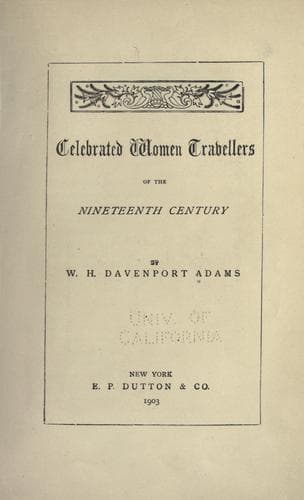
Celebrated Women Travellers of the Nineteenth Century — John Shaqi
Celebrated Women Travellers of the Nineteenth CenturyAdams, W. H. Davenport (William Henry Davenport)
History
Celebrated Women Travellers of the Nineteenth Century
Adams, W. H. Davenport (William Henry Davenport)
Women travelers -- Biography
"You see that it is a pretty _tableau de genre_, worthy of the brush of
Mentzel, the German painter, or of the French Meissonier. For background
the canvas will have the picturesque Louis Quatorze interiors of
Sans-Souci; in the foreground, the king and the great Humboldt, who
inclines towards the young girl; farther off, her sister leaning on
their father's arm, and the aged Rauch, who closes up the scene and
holds in his hand the bas-relief.
"That young girl, who has just given a proof of her erudition is Helena
Ghika, now famous under the literary pseudonym of Dora d'Istria. The old
man is the Prince Michael, her father, whose family, originally of
Epirus, has for the last two centuries been established in the Danubian
Principalities, and has supplied Wallachia with Hospodars. The other
young lady is Helena's sister."
* * * * *
Dora d'Istria was one of those fine, quick intelligences which look upon
the world--that is, upon humanity--as, in the poet's words, "The proper
study of mankind."
"It has always seemed to me," she one day observed, "that women, in
travelling, might complete the task of the most scientific travellers;
for, as a fact, woman carries certain special aptitudes into literature.
She perceives more quickly than man everything connected with national
life and the manners of the people. A wide field, much too neglected,
lies open, therefore, to her observation. But, in order that she may
fitly explore it, she needs, what she too often fails to possess, a
knowledge of languages and of history, as well as the capability of
conforming herself to the different habitudes of nations, and the
faculty of enduring great fatigues.
"Happily for myself, I was not deficient in linguistic knowledge. In my
family the only language made use of was French. M. Papadopoulos at an
early age taught me Greek, which in the East is as important as French
in the West. The Germanic tongues terrified me at first, the peoples of
Pelasgic origin having no taste for those idioms. But I was industrious
enough and patient enough to triumph over all such difficulties, and
though the study of languages is far from being popular in the Latin
countries, I did not cease to pursue it until the epoch of my marriage.
"M. Papadopoulos has often referred to my passionate love of history
even in my early childhood. This passion has constantly developed. The
more I have travelled, the more clearly I have perceived that one cannot
know a people unless one knows thoroughly its antecedents; that is, if
one be not fully acquainted with its annals and its chief writers. In
studying a nation only in its contemporary manifestations, one is
exposed to the error into which one would assuredly fall if one
attempted to estimate the character of an individual after living only a
few hours in his company.
Public-domain text, read in full here on John Shaqi.
Reviews
Reviews
No reviews yet
Be the first to share your thoughts on this work.
Join the Discussion
Join the discussion
Sign in to leave a comment or review.
Sign InorCreate an account