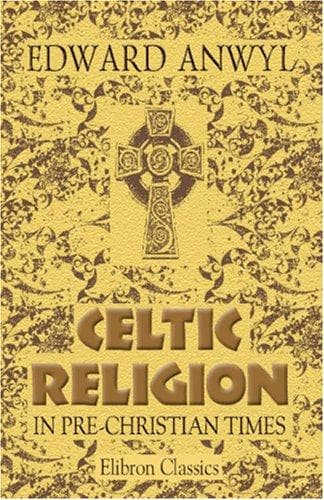
Celtic religion in pre-Christian timesAnwyl, E. (Edward)
Religion
Celtic religion in pre-Christian times
Anwyl, E. (Edward)
Celts -- Religion; Mythology, Celtic
Transcribed from the 1906 Archibald Constable & Co. Ltd. edition by David
Price, ccx074@coventry.ac.uk
CELTIC RELIGION
IN PRE-CHRISTIAN TIMES
By
EDWARD ANWYL, M.A.
LATE CLASSICAL SCHOLAR OF ORIEL COLLEGE, OXFORD
PROFESSOR OF WELSH AND COMPARATIVE PHILOLOGY AT
THE UNIVERSITY COLLEGE OF WALES, ABERYSTWYTH
ACTING-CHAIRMAN OF THE CENTRAL WELSH BOARD
FOR INTERMEDIATE EDUCATION
LONDON
ARCHIBALD CONSTABLE & CO LTD
16 JAMES STREET HAYMARKET
1906
Edinburgh: T. and A. CONSTABLE, Printers to His Majesty
FOREWORD
It is only as prehistoric archaeology has come to throw more and more
light on the early civilisations of Celtic lands that it has become
possible to interpret Celtic religion from a thoroughly modern viewpoint.
The author cordially acknowledges his indebtedness to numerous writers on
this subject, but his researches into some portions of the field
especially have suggested to him the possibility of giving a new
presentation to certain facts and groups of facts, which the existing
evidence disclosed. It is to be hoped that a new interest in the
religion of the Celts may thereby be aroused.
E. ANWYL.
ABERYSTWYTH,
_February_ 15, 1906.
CHAPTER I--INTRODUCTORY: THE CELTS
In dealing with the subject of 'Celtic Religion' the first duty of the
writer is to explain the sense in which the term 'Celtic' will be used in
this work. It will be used in reference to those countries and districts
which, in historic times, have been at one time or other mainly of Celtic
speech. It does not follow that all the races which spoke a form of the
Celtic tongue, a tongue of the Indo-European family, were all of the same
stock. Indeed, ethnological and archaeological evidence tends to
establish clearly that, in Gaul and Britain, for example, man had lived
for ages before the introduction of any variety of Aryan or Indo-European
speech, and this was probably the case throughout the whole of Western
and Southern Europe. Further, in the light of comparative philology, it
has now become abundantly clear that the forms of Indo-European speech
which we call Celtic are most closely related to those of the Italic
family, of which family Latin is the best known representative. From
this it follows that we are to look for the centre of dissemination of
Aryan Celtic speech in some district of Europe that could have been the
natural centre of dissemination also for the Italic languages. From this
common centre, through conquest and the commercial intercourse which
followed it, the tribes which spoke the various forms of Celtic and
Italic speech spread into the districts occupied by them in historic
times. The common centre of radiation for Celtic and Italic speech was
probably in the districts of Noricum and Pannonia, the modern Carniola,
Carinthia, etc., and the neighbouring parts of the Danube valley. The
conquering Aryan-speaking Celts and Italians formed a military
aristocracy, and their success in extending the range of their languages
Public-domain text, read in full here on John Shaqi.
Reviews
Reviews
No reviews yet
Be the first to share your thoughts on this work.
Join the Discussion
Join the discussion
Sign in to leave a comment or review.
Sign InorCreate an account