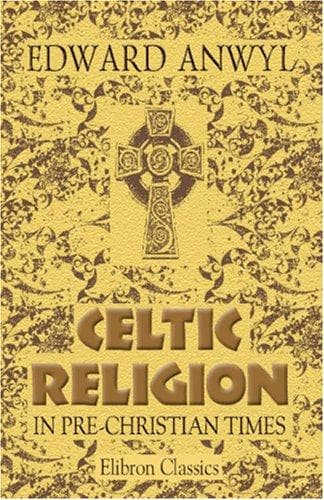
Celtic religion in pre-Christian timesAnwyl, E. (Edward)
Religion
Celtic religion in pre-Christian times
Anwyl, E. (Edward)
Celts -- Religion; Mythology, Celtic
elsewhere, after long epochs of vague unrest, came to realise that he was
somehow haunted in the daytime as well as at night, and it was this sense
of being haunted that impelled his intellect and his imagination to seek
some explanation of his feelings. Primitive man came to seek a solution
not of the Universe as a whole (for of this he had no conception), but of
the local Universe, in which he played a part. In dealing with Celtic
folk-lore, it is very remarkable how it mirrors the characteristic local
colouring and scenery of the districts in which it has originated. In a
country like Wales, for example, it is the folk-lore of springs, caves,
mountains, lakes, islands, and the forms of its imagination, here as
elsewhere, reflect unmistakably the land of its origin. Where it depicts
an 'other world,' that 'other world' is either on an island or it is a
land beneath the sea, a lake, or a river, or it is approachable only
through some cave or opening in the earth. In the hunting-grounds of the
Celtic world the primitive hunter knew every cranny of the greater part
of his environment with the accuracy born of long familiarity, but there
were some peaks which he could not scale, some caves which he could not
penetrate, some jungles into which he could not enter, and in these he
knew not what monsters might lurk or unknown beings might live. In
Celtic folk-lore the belief in fabulous monsters has not yet ceased. Man
was surrounded by dangers visible and invisible, and the time came when
some prehistoric man of genius propounded the view that all the objects
around him were no less living than himself. This animistic view of the
world, once adopted, made great headway from the various centres where it
originated, and man derived from it a new sense of kinship with his
world, but also new terrors from it. Knowing from the experience of
dreams that he himself seemed able to wander away from himself, he
thought in course of time that other living things were somehow double,
and the world around him came to be occupied, not merely with things that
were alive, but with other selves of these things, that could remain in
them or leave them at will. Here, again, this new prehistoric philosophy
gave an added interest to life, but it was none the less a source of
fresh terrors. The world swarmed with invisible spirits, some friendly,
some hostile, and, in view of these beings, life had to be regulated by
strict rules of actions and prohibitions. Even in the neolithic stage
the inhabitants of Celtic countries had attained to the religious ideas
in question, as is seen not only by their folk-lore and by the names of
groups of goddesses such as the Matres (or mothers), but by the fact that
in historic times they had advanced well beyond this stage to that of
named and individualised gods. As in all countries where the gods were
individualised, the men of Celtic lands, whether aborigines or invaders,
Public-domain text, read in full here on John Shaqi.
Reviews
Reviews
No reviews yet
Be the first to share your thoughts on this work.
Join the Discussion
Join the discussion
Sign in to leave a comment or review.
Sign InorCreate an account