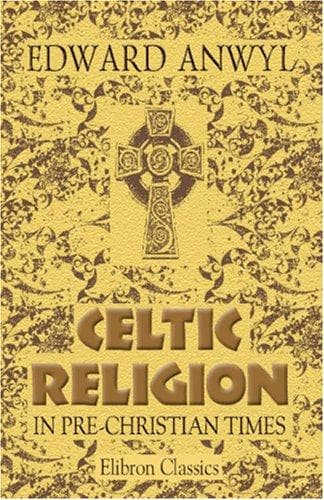
Celtic religion in pre-Christian times — John Shaqi
Celtic religion in pre-Christian timesAnwyl, E. (Edward)
Religion
Celtic religion in pre-Christian times
Anwyl, E. (Edward)
Celts -- Religion; Mythology, Celtic
Elysium in the words--'Admirable was that land: there are three trees
there always bearing fruit, one pig always alive, and another ready
cooked.' Occasionally, however, we find a different picture. In the
Welsh poem called 'Y Gododin' the poet Aneirin is represented as
expressing his gratitude at being rescued by the son of Llywarch Hen from
'the cruel prison of the earth, from the abode of death, from the
loveless land.' The salient features, therefore, of the Celtic
conceptions of the other-world are their consonance with the suggestions
made by Celtic scenery to the Celtic imagination, the vagueness and
variability of these conceptions in different minds and in different
moods, the absence of any ethical considerations beyond the incentive
given to bravery by the thought of immortality, and the remarkable
development of a sense of possible inter-relations between the two
worlds, whether pacific or hostile. Such conceptions, as we see from
Celtic legend, proved an admirable stimulus and provided excellent
material for the development of Celtic narrative, and the weird and
romantic effect was further heightened by the general belief in the
possibilities of magic and metamorphosis. Moreover, the association with
innumerable place-names of legends of this type gave the beautiful
scenery of Celtic lands an added charm, which has attached their
inhabitants to them with a subtle and unconquerable attachment scarcely
intelligible to the more prosaic inhabitants of prosaic lands. To the
poetic Celt the love of country tends to become almost a religion. The
Celtic mind cannot remain indifferent to lands and seas whose very beauty
compels the eyes of man to gaze upon them to their very horizon, and the
lines of observation thus drawn to the horizon are for the Celt continual
temptations to the thought of an infinity beyond. The preoccupation of
the Celtic mind with the deities of his scenery, his springs, his rivers,
his seas, his forests, his mountains, his lakes, was in thorough keeping
with the tenour of his mind, when tuned to its natural surroundings. In
dealing with Celtic religion, mythology, and legend, it is not so much
the varying local and temporal forms that demand our attention, as the
all-pervading and animating spirit, which shows its essential character
even through the scanty remains of the ancient Celtic world. Celtic
religion bears the impress of nature on earth far more than nature in the
heavens. The sense of the heaven above has perhaps survived in some of
the general Indo-European Celtic terms for the divine principle, and
there are some traces of a religious interest in the sun and the god of
thunder and lightning, but every student of Celtic religion must feel
that the main and characteristic elements are associated with the earth
in all the variety of its local phenomena. The great earth-mother and
her varied offspring ever come to view in Celtic religion under many
Public-domain text, read in full here on John Shaqi.
Reviews
Reviews
No reviews yet
Be the first to share your thoughts on this work.
Join the Discussion
Join the discussion
Sign in to leave a comment or review.
Sign InorCreate an account