MOORCROFT, PARKSTONE, DORSET.
_Christmas, 1910._
CONTENTS
CHAPTER PAGE
PREFACE v
I. ANTECEDENTS—LOMBROSO’S PREDECESSORS IN RESEARCH 1
II. CRIMINAL ANTHROPOLOGY 18
III. OPPOSITION TO LOMBROSO’S VIEWS—WOMAN AS CRIMINAL—THE
POLITICAL CRIMINAL—CRIMINAL PSYCHOLOGY 55
IV. GENERAL CONSIDERATIONS REGARDING LOMBROSO’S LIFE-WORK AS A
SOCIAL REFORMER, HIS METHODS, AND HIS PHILOSOPHY 106
V. THE SIGNIFICANCE OF CRIMINAL ANTHROPOLOGY 130
VI. CRIMINAL JURISPRUDENCE—PELLAGRA—AGRARIAN REFORM 139
VII. ENVIRONMENT AND THE THEORIES AS TO THE NATURE OF
GENIUS—LOMBROSO’S GENIUS AND PERSONALITY 158
APPENDIX A. LOMBROSO’S SPIRITUALISTIC RESEARCHES 167
APPENDIX B. LIST OF BOOKS CONSULTED 177
APPENDIX C. FACTS AND DOCUMENTS OF POSITIVISM 178
INDEX 182
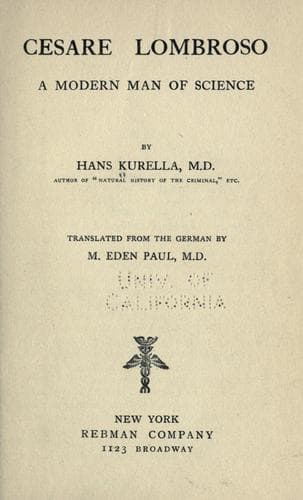
CESARE LOMBROSO
CHAPTER I
ANTECEDENTS—LOMBROSO’S PREDECESSORS IN RESEARCH
Cesare Lombroso was born in Verona, as an Austrian subject, on November
6, 1835, and was the second child in a family of five. His father Aron
sprang from a Venetian mercantile family, whose origin can be traced
back to a colony of North African Jews, trading with Leghorn, Genoa, and
Venice. Again and again members of the Lombroso family settled in one or
other of these ports. The branch to which he himself belonged had lived
for several centuries in Venice and the Venetian territories on the
mainland, of which from the year 1448 onwards Verona formed a part; they
were patrician merchants, to whom the French occupation, occurring
before Lombroso’s father grew up, had brought full and equal privileges
of citizenship.[1] Several members of this Venetian family were
distinguished by characteristic and vigorous action on behalf of the
cause of enlightenment. In Virginia, North America, in the seventeenth
century, the brother of a direct ancestor of Cesare Lombroso, at a great
risk to himself of being burned alive, protested most energetically
against the belief in witchcraft, and declared that the reputed witches
were “hysterical” merely.
The French emancipation of Upper Italy was followed in 1814 by the
Austrian reaction, but the family suffered at this time from the decline
in economic prosperity (interrupted for a while in 1830, when Venice
became a free port) upon which its own well-being and patrician position
had been dependent.
Public-domain text, read in full here on John Shaqi.
Reviews
Reviews
No reviews yet
Be the first to share your thoughts on this work.
Join the Discussion
Join the discussion
Sign in to leave a comment or review.
Sign InorCreate an account