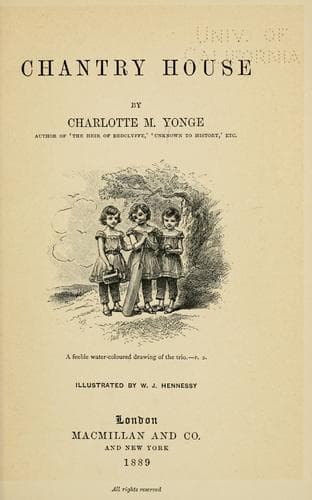
Domestic fiction; England -- Social life and customs -- 19th century -- Fiction; Family -- England -- Fiction
Formal folks, such as we were, had to sit in our chairs; and when he came
back apologising for not dressing, as he had left his portmanteau for the
carrier, he looked so white and ill that we were quite shocked, and began
to realise what he had suffered. He could not eat the food that was
brought back for him, and allowed that his head was aching dreadfully;
but, after a glass of wine had been administered, it was extracted that
he had met Mr. Frith at the office door, and been gruffly told that Mr.
Castleford was satisfied, and he might consider himself acquitted.
‘And then I had your letter, sir, thank you,’ said Clarence, scarcely
restraining his tears.
‘The thanks are on our side, my dear boy,’ said Mr. Castleford. ‘I must
talk it over with you, but not till you have had a night’s rest. You
look as if you had not known one for a good while.’
Clarence gave a sort of trembling smile, not trusting himself to speak.
Approbation at home was so new and strange to him that he could scarcely
bear it, worn out as he was by nearly a month of doubt, distress,
apprehension, and self-debate.
My mother went herself to hasten the preparation of his room, and after
she had sent him to bed went again to satisfy herself that he was
comfortable and not feverish. She came back wiping away a tear, and
saying he had looked up at her just as when she had the three of us in
our nursery cribs. In truth these two had seldom been so happy together
since those days, though the dear mother, while thankful that he had not
failed, was little aware of the conflict his resolution had cost him, and
the hot journey and long walk came in for more blame for his exhaustion
than they entirely deserved.
My father perhaps understood more of the trial; for when she came back,
declaring that all that was needed was sleep, and forbidding me to go to
my room before bedtime, he said he must bid the boy good-night.
And he spoke as his reserve would have never let him speak at any other
time, telling Clarence how deeply thankful he felt for the manifestation
of such truthfulness and moral courage as he said showed that the man had
conquered the failings of the boy.
Nevertheless, when I retired for the night, it was to find Clarence
asleep indeed, but most uneasily, tossing, moaning, and muttering broken
sentences about ‘disgracing his pennant,’ ‘never bearing to see mamma’s
face’—and the like. I thought it a kindness to wake him, and he started
up. ‘Ted, is it you? I thought I should never hear your dear old crutch
again! Is it really all right’—then, sitting up and passing his hand
over his face, ‘I always mix it up with the old affair, and think the
court-martial is coming again.’
‘There’s all the difference now.’
Public-domain text, read in full here on John Shaqi.
Reviews
Reviews
No reviews yet
Be the first to share your thoughts on this work.
Elsewhere in the archive
Join the Discussion
Join the discussion
Sign in to leave a comment or review.
Sign InorCreate an account