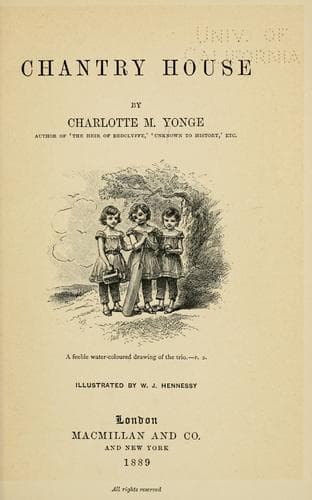
Domestic fiction; England -- Social life and customs -- 19th century -- Fiction; Family -- England -- Fiction
‘Thank God! yes—He has dragged me through! But it did not seem so in
one’s sleep, nor waking neither—though sleep is worst, and happily there
was not much of that! Sit down, Ted; I want to look at you. I can’t
believe it is not three weeks since I saw you last.’
We talked it all out, and I came to some perception of the fearful ordeal
it had been—first, in the decision neither to shut his eyes, nor to
conceal that they were open; and then in the lack of presence of mind and
the sense of confusion that always beset him when browbeaten and talked
down, so that, in the critical contest with Tooke, he felt as if his feet
were slipping from under him, and what had once been clear to him was
becoming dim, so that he had only been assured that he had held his
ground by Tooke’s redoubled persuasions and increased anger. And for a
clerk, whose years were only twenty-one, to oppose a manager, who had
been in the service more than the whole of that space, was preposterous
insolence, and likely to result in the utter ruin of his own prospects,
and the character he had begun to retrieve. It was just after this, the
real crisis, that he had the only dream which had not been misery and
distress. In it she—she yonder—yes, the lady with the lamp, came and
stood by him, and said, ‘Be steadfast.’
‘It was a dream,’ said Clarence. ‘She was not as she is in the mullion
room, not crying, but with a sweet, sad look, almost like Miss Fordyce—if
Miss Fordyce ever looked sad. It was only a dream.’
Yet it had so refreshed and comforted him that we have often since
discussed whether the spirit really visited him, or whether this was the
manner in which conscience and imagination acted on his brain. Indeed,
he always believed that the dream had been either heaven-sent or
heaven-permitted.
The die had been cast in that interview when he had let it be seen that
he was dangerous, and could not be bought over. The after consequences
had been the terrible distress and temptation I have before described,
only most inadequately. ‘But that,’ said Clarence, half smiling, ‘only
came of my being such a wretched creature as I am. There, dear old Miss
Newton saved me—yes, she did—most unconsciously, dear old soul. Don’t
you remember how Griff used to say she maundered over the text. Well,
she did it all the way home in my ear, as she clung to my arm—“Be strong,
and He shall comfort thine heart.” And then I knew my despair and
determination to leave it all behind were a temptation—“the old story,”
as you told me, and I prayed God to help me, and just managed to fight it
out. Thank God for her!’
Public-domain text, read in full here on John Shaqi.
Reviews
Reviews
No reviews yet
Be the first to share your thoughts on this work.
Elsewhere in the archive
Join the Discussion
Join the discussion
Sign in to leave a comment or review.
Sign InorCreate an account