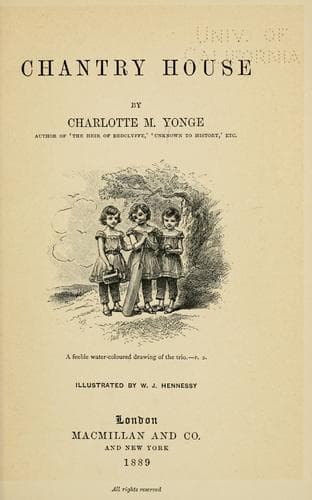
Domestic fiction; England -- Social life and customs -- 19th century -- Fiction; Family -- England -- Fiction
My mother thought the Navy the proper element of boyhood, and her uncle
the Admiral promised a nomination,—a simple affair in those happy days,
involving neither examination nor competition. Griffith was, however,
one of those independent boys who take an aversion to whatever is forced
on them as their fate. He was ready and successful with his studies, a
hero among his comrades, and preferred continuing at school to what he
pronounced, on the authority of the nautical tales freely thrown in our
way, to be the life of a dog, only fit for the fool of the family;
besides, he had once been out in a boat, tasted of sea-sickness, and been
laughed at. My father was gratified, thinking his brains too good for a
midshipman, and pleased that he should wish to tread in his own steps at
Harrow and Oxford, and thus my mother could not openly regret his
degeneracy when all the rest of us were crazy over _Tom Cringle’s Log_,
and ready to envy Clarence when the offer was passed on to him, and he
appeared in the full glory of his naval uniform. Not much choice had
been offered to him. My mother would have thought it shameful and
ungrateful to have no son available, my father was glad to have the boy’s
profession fixed, and he himself was rejoiced to escape from the miseries
he knew only too well, and ready to believe that uniform and dirk would
make a man of him at once, with all his terrors left behind. Perhaps the
chief drawback was that the ladies _would_ say, ‘What a darling!’
affording Griff endless opportunities for the good-humoured mockery by
which he concealed his own secret regrets. Did not even Selina Clarkson,
whose red cheeks, dark blue eyes, and jetty profusion of shining curls,
were our notion of perfect beauty, select the little naval cadet for her
partner at the dancing master’s ball?
In the first voyage, a cruise in the Pacific, all went well. The good
Admiral had carefully chosen ship and captain; there were an excellent
set of officers, a good tone among the midshipmen, and Clarence, who was
only twelve years old, was constituted the pet of the cockpit. One lad
in especial, Coles by name, attracted by Clarence’s pleasant gentleness,
and impelled by the generosity that shields the weak, became his guardian
friend, and protected him from all the roughnesses in his power. If
there were a fault in that excellent Coles, it was that he made too much
of a baby of his _protégé_, and did not train him to shift for himself:
but wisdom and moderation are not characteristics of early youth. At
home we had great enjoyment of his long descriptive letters, which came
under cover to our father at the Admiralty, but were chiefly intended for
my benefit. All were proud of them, and great was my elation when I
heard papa relate some fact out of them with the preface, ‘My boy tells
me, my boy Clarence, in the _Calypso_; he writes a capital letter.’
Public-domain text, read in full here on John Shaqi.
Reviews
Reviews
No reviews yet
Be the first to share your thoughts on this work.
Join the Discussion
Join the discussion
Sign in to leave a comment or review.
Sign InorCreate an account