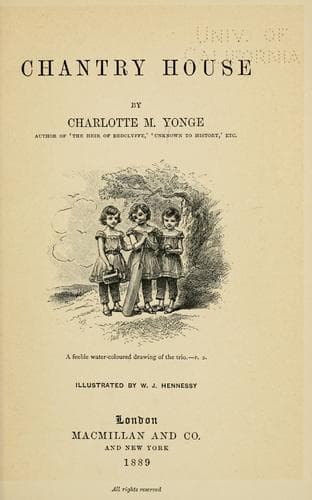
Domestic fiction; England -- Social life and customs -- 19th century -- Fiction; Family -- England -- Fiction
Not being ‘come out,’ she was left at home on the day when we set out on
a regular progress in the chariot with post-horses. The britshka and
pair, which were our ambition, were to wait till my father’s next rents
came in. Morning calls in the country were a solemn and imposing
ceremony, and the head of the family had to be taken on the first
circuit; nor was there much scruple as to making them in the forenoon, so
several were to be disposed of before fulfilling an engagement to
luncheon at the farthest point, where some old London friends had
borrowed a house for the summer, and had included me in their invitation.
Here alone did I leave the carriage, but I had Cooper’s _Spy_ and my
sketch-book as companions while waiting at doors where the inhabitants
were at home. The last visit was at Hillside Rectory, a house of
architecture somewhat similar to our own, but of the soft creamy stone
which so well set off the vine with purple clusters, the myrtles and
fuchsias, that covered it. I was wishing we had drawn up far enough off
for a sketch to be possible, when, from a window close above, I heard the
following words in a clear girlish voice—
‘No, indeed! I’m not going down. It is only those horrid Earlscombe
people. I can’t think how they have the face to come near us!’
There was a reply, perhaps that the parents had made the first visit, for
the rejoinder was—‘Yes; grandpapa said it was a Christian duty to make an
advance; but they need not have come so soon. Indeed, I wonder they show
themselves at all. I am sure I would not if I had such a dreadful son.’
Presently, ‘I hate to think of it. That I should have thanked him.
Depend upon it, he will never pay the doctor. A coward like that is
capable of anything.’
The proverb had been realised, but there could hardly have been a more
involuntary or helpless listener. Presently my parents came back,
escorted by both the gentlemen of the house, tall fine-looking men, the
elder with snowy hair, and the dignity of men of the old school; the
younger with a joyous, hearty, out-of-door countenance, more like a
squire than a clergyman.
The visit seemed to have been gratifying. Mrs. Fordyce was declared to
be of higher stamp than most of the neighbouring ladies; and my father
was much pleased with the two clergymen, while as we drove along he kept
on admiring the well-ordered fields and fences, and contrasting the
pretty cottages and trim gardens with the dreary appearance of our own
village. I asked why Amos Bell’s home had been neglected, and was
answered with some annoyance, as I pointed down the lane, that it was on
our land, though in Hillside parish. ‘I am glad to have such
neighbours!’ observed my mother, and I kept to myself the remarks I had
heard, though I was still tingling with the sting of them.
Public-domain text, read in full here on John Shaqi.
Reviews
Reviews
No reviews yet
Be the first to share your thoughts on this work.
Join the Discussion
Join the discussion
Sign in to leave a comment or review.
Sign InorCreate an account