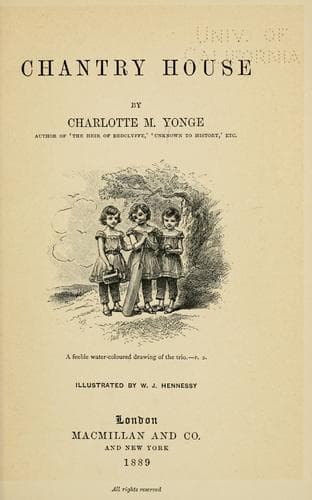
Domestic fiction; England -- Social life and customs -- 19th century -- Fiction; Family -- England -- Fiction
Clarence went without a word, but Griff and I burst out with entreaties
to be listened to. Our father thought at first that ours were only the
pleadings of partiality, and endeavours to shield the brother we both so
heartily loved; but when he understood the circumstances, the real amount
of the transgression, and Clarence’s rejection of our united advice and
assistance to conceal it, he was greatly touched and softened. ‘Poor
lad! poor fellow!’ he muttered, ‘he is really doing his best. I need not
have cut him so short. I was afraid of more falsehoods if I let him open
his mouth. I’ll go and see.’
He went off, and we remained in suspense, Griff observing that he had
done his best, but poor Bill always would be a fool, and that no one who
had not always lived at home like me would have let out that we had been
for the suppression policy. As I was rather shocked, he went off to bed,
saying he should look in to see what remained of Clarence after the
pelting of the pitiless storm he was sure to bring on himself by his
ridiculous faltering instead of speaking out like a man.
I longed to have been able to do the same, but my father kindly came back
to relieve my mind by telling me that he was better satisfied about
Clarence than ever he had been before. When encouraged to speak out, the
narrative of the temptation had so entirely agreed with what we had said
as to show there had been no prevarication, and this had done more to
convince my father that he was on the right track than the having found
him on his knees. He had had a patient hearing, and thus was able to
command his nerves enough to explain himself, and it had ended in my
father giving entire forgiveness for what, as Griff truly said, would
have been a mere trifle but for the past. The voluntary confession had
much impressed my father, and he could not help adding a word of gentle
reproof to me for having joined in aiding him to withhold it, but he
accepted my explanation and went away, observing, ‘By the by, I don’t
wonder at what Griffith says of that room; I never heard such strange
effects of currents of air.’
Clarence was in my room before I was drest, full of our father’s
‘wonderful goodness’ to him. He had never experienced anything like it,
he said. ‘Why! he really seemed hopeful about me,’ were words uttered
with a gladness enough to go to one’s heart. ‘O Edward, I feel as if
there was some chance of “steadfastly purposing” this time.’
It was not the way of the family to say much of religious feeling, and
this was much for Clarence to utter. He looked white and tired, but
there was an air of rest and peace about him, above all when my mother
met him with a very real kiss. Moreover, Mr. Castleford had taken care
to brighten our Christmas with a letter expressive of great satisfaction
with Clarence for steadiness and intelligence. Even Mr. Frith allowed
that he was the most punctual of all those young dogs.
Public-domain text, read in full here on John Shaqi.
Reviews
Reviews
No reviews yet
Be the first to share your thoughts on this work.
Join the Discussion
Join the discussion
Sign in to leave a comment or review.
Sign InorCreate an account