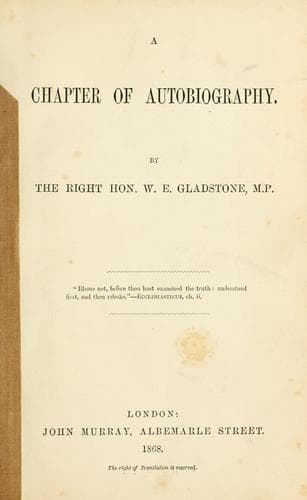
Chapter of AutobiographyGladstone, W. E. (William Ewart)
Religion
Chapter of Autobiography
Gladstone, W. E. (William Ewart)
Church of Ireland -- Establishment and disestablishment; Gladstone, W. E. (William Ewart), 1809-1898
The book goes on to describe that incapacity, however produced, as a
social defect and calamity. But the latter part of the work, instead
of acknowledging such incapacity as a sufficient and indeed commanding
plea for abstention, went beyond the bounds of moderation, and treated
it as if it must in all cases be a sin; as though any association
of men, in civil government or otherwise, could be responsible for
acting beyond the line of the capabilities determined for it by its
constitution and composition. My meaning I believe was, to describe
only cases in which there might be a deliberate renunciation of
such duties as there was the power to fulfil. But the line is left
too obscurely drawn between this wilful and wanton rejection of
opportunities for good, and the cases in which the state of religious
convictions, together with the recognised principles of government,
disable the civil power from including within its work the business of
either directly or indirectly inculcating religion, and mark out for it
a different line of action.
I believe that the foregoing passages describe fairly, if succinctly,
the main propositions of 'The State in its Relations with the Church;'
so far as the book bears upon the present controversy. They bound me
hand and foot: they hemmed me in on every side. Further on I shall
endeavour to indicate more clearly in what I think the book was right,
and in what it was wrong. What I have now to show is the manner in
which I retreated from an untenable position. To this retreat, and
the time and mode of it, I now draw attention, and I will endeavour
to apply to them the tests I have already laid down:--Was it sudden?
Was it performed with an indecent levity? Was it made to minister
to the interests of political ambition? Was the gravity of the case
denied or understated? Was it daringly pretended that there had been
no real change of front; and that, if the world had understood me
otherwise, it had misunderstood me? My opinion of the Established
Church of Ireland now is the direct opposite of what it was then. I
then thought it reconcilable with civil and national justice; I now
think the maintenance of it grossly unjust. I then thought its action
was favourable to the interests of the religion which it teaches; I now
believe it to be opposed to them.
Public-domain text, read in full here on John Shaqi.
Reviews
Reviews
No reviews yet
Be the first to share your thoughts on this work.
Join the Discussion
Join the discussion
Sign in to leave a comment or review.
Sign InorCreate an account