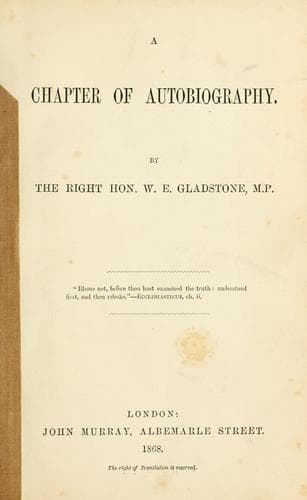
Chapter of AutobiographyGladstone, W. E. (William Ewart)
Religion
Chapter of Autobiography
Gladstone, W. E. (William Ewart)
Church of Ireland -- Establishment and disestablishment; Gladstone, W. E. (William Ewart), 1809-1898
In the course of the year 1844, when I was a member of the Cabinet of
Sir Robert Peel, he made known to me his opinion that it was desirable
to remodel and to increase the Grant to Maynooth. I was the youngest
member of that Government, entirely bound up with it in policy, and
warmly attached, by respect and even affection, to its head and to
some of its leading members. Of association with what was termed
ultra-Toryism in general politics I had never dreamed. I well knew
that the words of Sir R. Peel were not merely tentative, but that, as
it was right they should, they indicated a fixed intention. The choice
before me, therefore, was, to support his measure, or to retire from
his Government into a position of complete isolation, and what was
more than this, subject to a grave and general imputation of political
eccentricity. My retirement, I knew, could have no other warrant than
this: that it would be a tribute to those laws which, as I have urged,
must be upheld for the restraint of changes of opinion and conduct in
public men. For I never entertained the idea of opposing the measure
of Sir Robert Peel. I can scarcely be guilty of a breach of confidence
when I mention that Lord Derby, to whom I had already been indebted
for much personal kindness, was one of those colleagues who sought to
dissuade me from resigning my office. He urged upon me that such an
act must be followed by resistance to the measure of the Government,
and that I should run the risk of being mixed with a fierce religious
agitation. I replied that I must adhere to my purpose of retirement,
but that I did not perceive the necessity of its being followed by
resistance to the proposal. Overtures were, not unnaturally, made to
me by some of those who resisted it; but they were at once declined. My
whole purpose was to place myself in a position in which I should be
free to consider my course without being liable to any just suspicion
on the ground of personal interest. It is not profane if I say "with
a great price obtained I this freedom." The political association in
which I stood was to me at the time the alpha and omega of public life.
The Government of Sir Robert Peel was believed to be of immovable
strength. My place, as President of the Board of Trade, was at the very
kernel of its most interesting operations; for it was in progress from
year to year, with continually waxing courage, towards the emancipation
of industry, and therein towards the accomplishment of another great
and blessed work of public justice. Giving up what I highly prized,
aware that
"malè sarta
Gratia nequicquam coit, et rescinditur,"[7]
Public-domain text, read in full here on John Shaqi.
Reviews
Reviews
No reviews yet
Be the first to share your thoughts on this work.
Join the Discussion
Join the discussion
Sign in to leave a comment or review.
Sign InorCreate an account