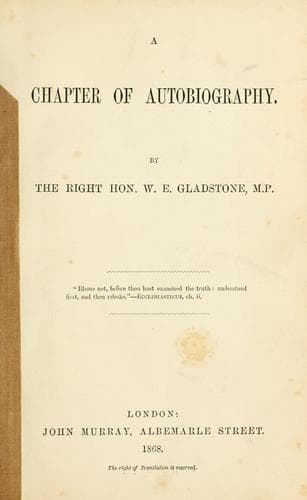
Chapter of AutobiographyGladstone, W. E. (William Ewart)
Religion
Chapter of Autobiography
Gladstone, W. E. (William Ewart)
Church of Ireland -- Establishment and disestablishment; Gladstone, W. E. (William Ewart), 1809-1898
The motives, which incline me to answer these questions in the
affirmative, are mainly two. First, that the great and glaring
change in my course of action with respect to the Established Church
of Ireland is not the mere eccentricity, or even perversion, of an
individual mind, but connects itself with silent changes, which are
advancing in the very bed and basis of modern society. Secondly, that
the progress of a great cause, signal as it has been and is, appears
liable nevertheless to suffer in point of credit, if not of energy and
rapidity, from the real or supposed delinquencies of a person, with
whose name for the moment it happens to be specially associated.
One thing is clear: that if I am warranted in treating my own case as
an excepted case, I am bound so to treat it. It is only with a view to
the promotion of some general interest, that the public can becomingly
be invited to hear more, especially in personal history, about an
individual, of whom they already hear too much. But if it be for the
general interest to relieve 'an enterprise of pith and moment' from the
odium of baseness, and from the lighter reproach of precipitancy, I
must make the attempt; though the obtrusion of the first person, and of
all that it carries in its train, must be irksome alike to the reader
and the writer.
So far, indeed, as my observation has gone, the Liberal party of this
country have stood fire unflinchingly under the heavy vollies which
have been fired into its camp with ammunition that had been drawn
from depositories full only with matter personal to myself. And, with
the confidence they entertain in the justice and wisdom of the policy
they recommend, it would have been weak and childish to act otherwise.
Still, I should be glad to give them the means of knowing that the case
may not after all be so scandalous as they are told. In the year 1827,
if I remember right, when Mr. Canning had just become Prime Minister,
an effort was made to support him in the town of Liverpool, where the
light and music of his eloquence had not yet died away, by an Address
to the Crown. The proposal was supported by an able and cultivated
Unitarian Minister, Mr. Shepherd, who had been one of Mr. Canning's
opponents at former periods in the Liverpool elections. Vindicating
the consistency of his course, he said he was ready to support the
devil himself, if it had been necessary, in doing good. This was a
succinct and rough manner of disposing of the question in the last
resort. I hope, however, that those who sustain the Liberal policy
respecting the Established Church of Ireland, will not be driven to
so dire an extremity. It can hardly be deemed on my part an unnatural
desire, that political friends, and candid observers, should on grounds
of reason and knowledge, and not merely from friendly prepossession,
feel themselves warranted not to believe in the justice of language
such as by way of example I subjoin. I must, however, suppose that the
Public-domain text, read in full here on John Shaqi.
Reviews
Reviews
No reviews yet
Be the first to share your thoughts on this work.
Join the Discussion
Join the discussion
Sign in to leave a comment or review.
Sign InorCreate an account