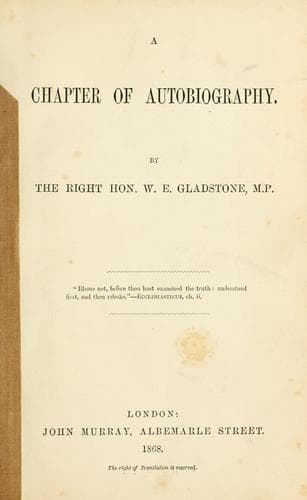
Chapter of AutobiographyGladstone, W. E. (William Ewart)
Religion
Chapter of Autobiography
Gladstone, W. E. (William Ewart)
Church of Ireland -- Establishment and disestablishment; Gladstone, W. E. (William Ewart), 1809-1898
The next Parliamentary occasion, after the Maynooth Grant, which
brought prominently into view the ecclesiastical arrangements of
Ireland, was that of the Ecclesiastical Titles Bill in 1851. I felt
bound, as one of a very small minority, but in cordial agreement with
the chief surviving associates of Sir Robert Peel, to offer all the
opposition in my power, not only to the clauses by which the party then
called Protectionist, and now Tory, Conservative, or Constitutionalist,
endeavoured to sharpen the sting of the measure, but to the substance
of the measure itself. I may be permitted to observe, that for the
representative of the University of Oxford thus to set himself against
the great bulk of the Liberal as well as the Conservative party,
whatever else it may have been, was not a servile or a self-seeking
course. But this is irrelevant. It is more to the present purpose
to observe that, in resisting this measure, I did not attempt to
mitigate the offence by any profession of adhesion in principle to
the maintenance of the Established Church of Ireland; but I spoke as
follows:--
"We cannot change the profound and resistless tendencies
of the age towards religious liberty. It is our business
to guide and control their application. Do this you may.
But to endeavour to turn them backwards is the sport of
children, done by the hands of men; and every effort
you may make in that direction will recoil upon you in
disaster and disgrace."[13]
The years flowed on. From 1846 forwards, the controversy of Free Trade
was, as a rule, the commanding and absorbing controversy, the pole of
political affairs. But from time to time motions were made in relation
to the Established Church of Ireland. That question remained as one
asleep, but whose sleep is haunted with uneasy dreams. These motions
were, as far as I remember them, uniformly of a narrow and partial
character. They aimed at what is called getting in the thin end of
the wedge. All honour, however, to each one of those who made them.
The mover of any such proposal was _vox clamantis in deserto_. The
people of England had, in 1835-8, settled the matter for the time.
The reproaches now made against the older leaders and the body of the
Liberal party for not having seriously entered the struggle, appear
to me to be not only unjust but even preposterous. The Legislature
had other great subjects to deal with, besides the Irish Church. Four
years of deadly conflict on such a matter might well be followed by
five times four of repose. But in the mean time individuals, by their
partial and occasional efforts, bore witness to a principle broader
than any which they formally announced. That principle--the application
of a true religious equality to Ireland--was biding its time.
Public-domain text, read in full here on John Shaqi.
Reviews
Reviews
No reviews yet
Be the first to share your thoughts on this work.
Join the Discussion
Join the discussion
Sign in to leave a comment or review.
Sign InorCreate an account