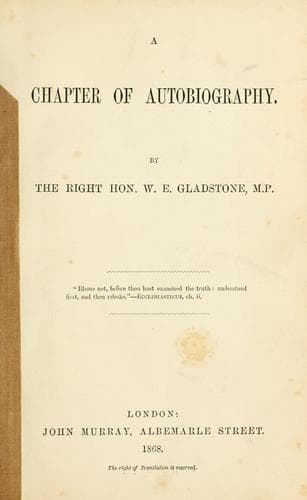
Chapter of AutobiographyGladstone, W. E. (William Ewart)
Religion
Chapter of Autobiography
Gladstone, W. E. (William Ewart)
Church of Ireland -- Establishment and disestablishment; Gladstone, W. E. (William Ewart), 1809-1898
The letter has been the object of much criticism upon these three
grounds. First, it contained a statement that the Act of Union ought to
entail important consequences in the formation of any measure relating
to the Irish Church. Secondly, that the question was hardly within
the domain of practical politics. Thirdly, that I felt very uncertain
whether it would be dealt with in my time. The explanation of the first
is as follows:--In contemplating the subject of the Irish Church, I did
not see how to give full effect to the principle of religious equality
without touching the composition of the House of Lords. In this strait,
my personal opinion was that it would be best to retain (though in an
altered form) the Episcopal element from Ireland in the House of Lords,
lest its withdrawal should lead to other changes, of a kind to weaken
the constitution of that important branch of the legislature; and thus
far I was disposed to abridge the application of religious equality to
Ireland. I had not yet examined the question so closely as to perceive
that this mode of proceeding was wholly impracticable, and that the
inconvenience of removing the Irish Bishops must be faced. And for my
part I have not been so happy, at any time of my life, as to be able
sufficiently to adjust the proper conditions of handling any difficult
question, until the question itself was at the door. This retention of
the Bishops in the House of Peers was the important consequence that I
thought the Act of Union would draw.
Among those errors of the day which may be called singular as vulgar
errors, is that which supposes the fifth Article of the Act of Union
with Ireland to refer to the endowments of the Church. Its terms touch
exclusively her "doctrine, worship, discipline, and government." There
is no violation of this section of the Act of Union in withdrawing her
endowments, were she stripped of every shilling. But it may be said
that her "government," as distinguished from her discipline, perhaps
involves the position of her exclusive relation to the State. So I
thought; and accordingly thus I wrote to Dr. Hannah.
The second proposition of the letter was not only in harmony with my
speech, it was simply the condensation of the speech into a brief form
of words. For, agreeing with Mr. Dillwyn as to the merits of the case,
I held, as I have ever held, that it is not the duty of a Minister to
be forward in inscribing on the Journals of Parliament his own abstract
views; or to disturb the existence of a great institution like the
Church of Ireland, until he conceives the time to be come when he can
probably give effect to his opinions. Because the question was not
within the range of practical politics, agreeing with his sentiment, I
voted against his motion.
Public-domain text, read in full here on John Shaqi.
Reviews
Reviews
No reviews yet
Be the first to share your thoughts on this work.
Join the Discussion
Join the discussion
Sign in to leave a comment or review.
Sign InorCreate an account