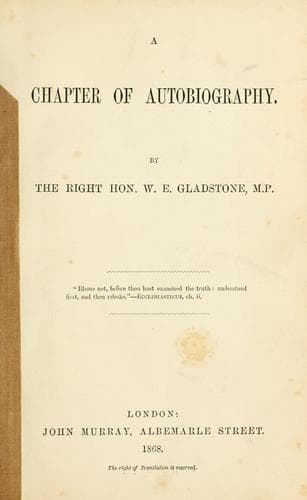
Chapter of AutobiographyGladstone, W. E. (William Ewart)
Religion
Chapter of Autobiography
Gladstone, W. E. (William Ewart)
Church of Ireland -- Establishment and disestablishment; Gladstone, W. E. (William Ewart), 1809-1898
And surely it would have required either a deeply saturnine or a
marvellously prophetic mind to foretell that, in ten or twelve more
years, that powerful and distinguished generation of clergy would
be broken up: that at least a moiety of the most gifted sons, whom
Oxford had reared for the service of the Church of England, would be
hurling at her head the hottest bolts of the Vatican: that, with their
deviation on the one side, there would arise a not less convulsive
rationalistic movement on the other; and that the natural consequences
would be developed in endless contention and estrangement, and in
suspicions worse than either, because even less accessible, and even
more intractable. Since that time, the Church of England may be said
to have bled at every pore; and at this hour it seems occasionally
to quiver to its very base. And yet, all the while, the religious
life throbs more and more powerfully within her. Shorn of what may be
called the romance and poetry of her revival, she abates nothing of
her toil; and in the midst of every sort of partial indiscretion and
extravagance, her great office in the care of souls is, from year to
year, less and less imperfectly discharged. But the idea of asserting
on her part those exclusive claims, which become positively unjust in a
divided country governed on popular principles, has been abandoned by
all parties in the State.
There was an error not less serious in my estimate of English
Nonconformity. I remember the astonishment with which at some
period,--I think in 1851-2,--after ascertaining the vast addition which
had been made to the number of churches in the country, I discovered
that the multiplication of chapels, among those not belonging to
the Church of England, had been more rapid still. But besides the
immense extension of its material and pastoral organisation, English
Nonconformity (in general) appears now to have founded itself on a
principle of its own, which forbids the alliance of the civil power
with religion in any particular form or forms. I do not embrace that
principle. But I must observe, in passing, that it is not less unjust
than it is common to stigmatise those who hold it as "political
Dissenters,"--a phrase implying that they do not dissent on religious
grounds. But if they, because they object to the union of Church and
State, are political Dissenters, it follows that all who uphold it are
political Churchmen.
Public-domain text, read in full here on John Shaqi.
Reviews
Reviews
No reviews yet
Be the first to share your thoughts on this work.
Join the Discussion
Join the discussion
Sign in to leave a comment or review.
Sign InorCreate an account