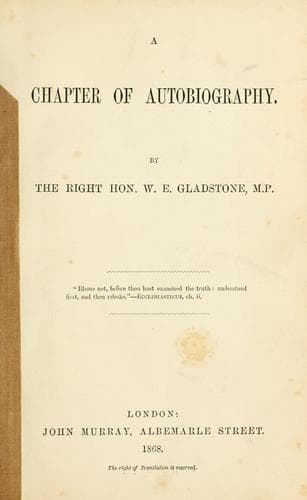
Chapter of AutobiographyGladstone, W. E. (William Ewart)
Religion
Chapter of Autobiography
Gladstone, W. E. (William Ewart)
Church of Ireland -- Establishment and disestablishment; Gladstone, W. E. (William Ewart), 1809-1898
These sentences, I think, give a fair view of Lord Macaulay's
philosophy of Church Establishments. It has all the clearness and
precision that might be expected from him. But I own myself unable to
accept it as it stands. I presume to think that perhaps Lord Macaulay,
like myself, made, from a limited induction, a hasty generalisation.
The difference was, that his theory was right for the practical
purpose of the time, while mine was wrong. Considered, however, in the
abstract, that theory appears to me to claim kindred with the ethical
code of another writer, not less upright, and not less limpid, so to
speak, than Lord Macaulay himself, I mean Dr. Paley. And the upshot of
it may be comprised in three words: Government is police. All other
functions, except those of police proper, are the accidents of its
existence. As if a man should say to his friend when in the country,
"I am going up to town; can I take anything for you?" So the State,
while busy about protecting life and property, will allow its officer
of police to perform any useful office for the community, to instruct
a wayfarer as to his road, or tell the passer by what o'clock it is,
provided it does not interfere with his watching the pickpocket, or
laying the strong hand upon the assassin. I doubt if it is possible
to cut out, as it were, with a pair of scissors, patterns of policy,
which shall solve for all time and place the great historic problem of
the relation of the civil power to religion.
It seems to me that in every function of life, and in every combination
with his fellow-creatures, for whatever purpose, the duties of man are
limited only by his powers. It is easy to separate, in the case of a
Gas Company or a Chess Club, the primary end for which it exists, from
everything extraneous to that end. It is not so easy in the case of the
State or of the family. If the primary end of the State is to protect
life and property, so the primary end of the family is to propagate
the race. But around these ends there cluster, in both cases, a group
of moral purposes, variable indeed with varying circumstances, but
yet inhering in the relation, and not external or merely incidental
to it. The action of man in the State is moral, as truly as it is in
the individual sphere; although it be limited by the fact that, as
he is combined with others whose views and wills may differ from his
own, the sphere of the common operations must be limited, first, to
the things in which all are agreed; secondly, to the things in which,
though they may not be agreed, yet equity points out, and the public
sense acknowledges, that the whole should be bound by the sense of the
majority.
Public-domain text, read in full here on John Shaqi.
Reviews
Reviews
No reviews yet
Be the first to share your thoughts on this work.
Join the Discussion
Join the discussion
Sign in to leave a comment or review.
Sign InorCreate an account