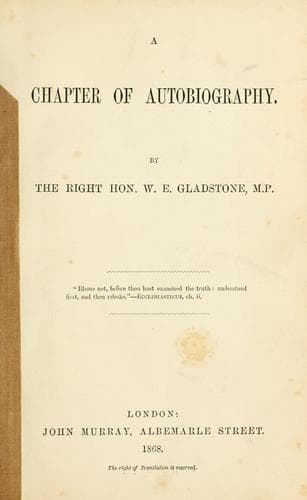
Chapter of AutobiographyGladstone, W. E. (William Ewart)
Religion
Chapter of Autobiography
Gladstone, W. E. (William Ewart)
Church of Ireland -- Establishment and disestablishment; Gladstone, W. E. (William Ewart), 1809-1898
But there are two causes, the combined operation of which, upon
reaching a certain point of development, relaxes or dissolves their
union by a process as normal (if it be less beneficial) as that by
which the union was originally brought about. One of these is the
establishment of the principle of popular self-government as the
basis of political constitutions. The other is the disintegration of
Christendom from one into many communions. As long as the Church at
large, or the Church within the limits of the nation, is substantially
one, I do not see why the religious care of the subject, through
a body properly constituted for the purpose, should cease to be a
function of the State, with the whole action and life of which it has,
throughout Europe, been so long and so closely associated. As long as
the State holds, by descent, by the intellectual superiority of the
governing classes, and by the good will of the people, a position of
original and underived authority, there is no absolute impropriety,
but the reverse, in its commending to the nation the greatest of all
boons. But when, either by some Revolution of institutions from their
summit to their base, or by a silent and surer process, analogous to
that which incessantly removes and replaces the constituent parts of
the human body, the State has come to be the organ of the deliberate
and ascertained will of the community, expressed through legal
channels--then the inculcation of a religion can no longer rest, in
full or permanent force, upon its authority. When, in addition to this,
the community itself is split and severed into opinions and communions,
which, whatever their concurrence in the basis of Christian belief, are
hostile in regard to the point at issue, so that what was meant for the
nation dwindles into the private estate as it were of a comparative
handful--the attempt to maintain an Established Church becomes an
error fatal to the peace, dangerous perhaps even to the life, of civil
society. Such a Church then becomes (to use a figure I think of John
Foster's), no longer the temple, but the mere cemetery, of a great
idea. Such a policy is then not simply an attempt to treat what is
superannuated and imbecile as if it were full of life and vigour, but
to thwart the regular and normal action of the ruling social forces, to
force them from their proper channels, and to turn them by artificial
contrivance, as Apollo turned the rivers of Troas from their beds, to a
purpose of our own. This is to set caprice against nature; and the end
must be that, with more or less of delay, more or less of struggle or
convulsion, nature will get the better of caprice.
Public-domain text, read in full here on John Shaqi.
Reviews
Reviews
No reviews yet
Be the first to share your thoughts on this work.
Join the Discussion
Join the discussion
Sign in to leave a comment or review.
Sign InorCreate an account