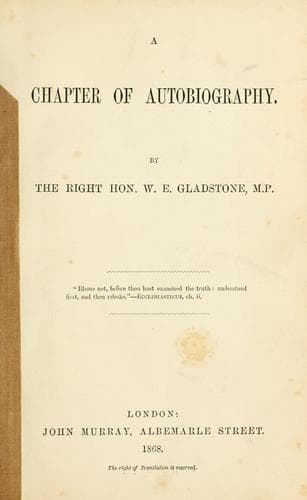
Chapter of AutobiographyGladstone, W. E. (William Ewart)
Religion
Chapter of Autobiography
Gladstone, W. E. (William Ewart)
Church of Ireland -- Establishment and disestablishment; Gladstone, W. E. (William Ewart), 1809-1898
The gradual transfer of political power from groups and limited classes
to the community, and the constant seething of the public mind, in
fermentation upon a vast mass of moral and social, as well as merely
political, interests, offer conditions of action, in which it is
evident that the statesman, in order to preserve the same amount of
consistency as his antecessors in other times, must be gifted with
a far larger range of foresight. But Nature has endowed him with no
such superiority. It may be true that Sir Robert Peel shewed this
relative deficiency in foresight, with reference to Roman Catholic
Emancipation, to Reform, and to the Corn Law. It does not follow that
many, who have escaped the reproach, could have stood the trial. For
them the barometer was less unsteady; the future less exacting in its
demands. But let us suppose that we could secure this enlargement of
onward view, this faculty of measuring and ascertaining to-day the
wants of a remote hereafter, in our statesmen; we should not even
then be at the end of our difficulties. For the public mind is to a
great degree unconscious of its own progression; and it would resent
and repudiate, if offered to its immature judgment, the very policy,
which after a while it will gravely consider, and after another while
enthusiastically embrace.
Yet, as it still remains true that the actual opinions and professions
of men in office, and men in authority without office, are among the
main landmarks on which the public has to rely, it may seem that, in
vindicating an apparent liberty of change, we destroy the principal
guarantees of integrity which are available for the nation at large,
and with these all its confidence in the persons who are to manage
its affairs. This would be a consequence so fatal, that it might even
drive us back upon the hopeless attempt to stereotype the minds of men,
and fasten on their manhood the swaddling clothes of their infancy.
But such is not the alternative. We may regulate the changes which we
cannot forbid, by subjecting them to the test of public scrutiny, and
by directing that scrutiny to the enforcement of the laws of moral
obligation. There are abundant signs, by which to distinguish between
those changes, which prove nothing worse than the fallibility of the
individual mind, and man[oe]uvres which destroy confidence, and entail
merited dishonour. Changes which are sudden and precipitate--changes
accompanied with a light and contemptuous repudiation of the former
self--changes which are systematically timed and tuned to the interest
of personal advancement--changes which are hooded, slurred over, or
denied--for these changes, and such as these, I have not one word to
say; and if they can be justly charged upon me, I can no longer desire
that any portion, however small, of the concerns or interests of my
countrymen should be lodged in my hands.
Public-domain text, read in full here on John Shaqi.
Reviews
Reviews
No reviews yet
Be the first to share your thoughts on this work.
Join the Discussion
Join the discussion
Sign in to leave a comment or review.
Sign InorCreate an account