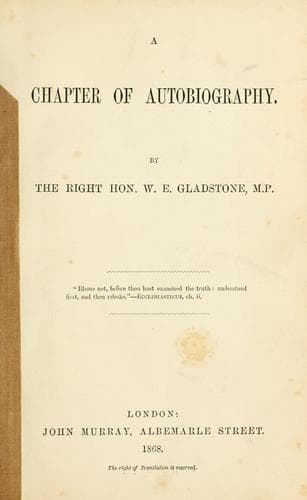
Chapter of AutobiographyGladstone, W. E. (William Ewart)
Religion
Chapter of Autobiography
Gladstone, W. E. (William Ewart)
Church of Ireland -- Establishment and disestablishment; Gladstone, W. E. (William Ewart), 1809-1898
In the mean time I hope you will allow me to apprise
you that on one material point especially I am not so
far removed from you as you suppose. I am not conscious
that I have said either that the _Test Act_ should be
repealed, or that it should not have been passed: and
though on such subjects language has many bearings which
escape the view of the writer at the moment when the pen
is in his hand, yet I think that I can hardly have put
forth either of these propositions, because I have never
entertained the corresponding sentiments. Undoubtedly
I should speak of the pure abstract idea of Church and
State as implying that they are co-extensive: and I
should regard the present composition of the State of the
United Kingdom as a deviation from that pure idea, but
only in the same sense as all differences of religious
opinion in the Church are a deviation from its pure
idea, while I not only allow that they are permitted,
but believe that (within limits) they were intended to
be permitted. There are some of these deflections from
abstract theory which appear to me allowable; and that
of the admission of persons not holding the national
creed into civil office is one which, in my view, must
be determined by times and circumstances. At the same
time I do not recede from any protest which I have
made against the principle, that religious differences
are irrelevant to the question of competency for civil
office: but I would take my stand between the opposite
extremes, the one that no such differences are to be
taken into view, the other that all such differences are
to constitute disqualifications.
I need hardly say the question I raise is not whether you
have misrepresented me, for, were I disposed to anything
so weak, the whole internal evidence and clear intention
of your article would confute me: indeed I feel I ought
to apologize for even supposing that you may have been
mistaken in the apprehension of my meaning, and I freely
admit on the other hand the possibility that, totally
without my own knowledge, my language may have led to
such an interpretation.
In these lacerating times one clings to everything of
personal kindness in the past, to husband it for the
future, and if you will allow me I shall earnestly desire
to carry with me such a recollection of your mode of
dealing with the subject; upon which, the attainment
of truth, we shall agree, so materially depends upon
the temper in which the search for it is instituted and
conducted.
I did not mean to have troubled you at so much length,
and I have only to add that I am, with much respect,
Public-domain text, read in full here on John Shaqi.
Reviews
Reviews
No reviews yet
Be the first to share your thoughts on this work.
Join the Discussion
Join the discussion
Sign in to leave a comment or review.
Sign InorCreate an account