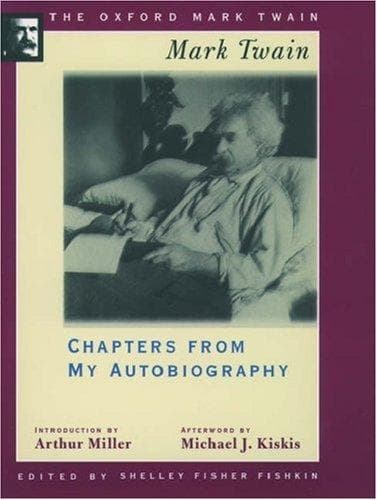
Authors, American -- 19th century -- Biography; Humorists, American -- 19th century -- Biography; Twain, Mark, 1835-1910
another boy in the school that could approach this feat. He had not a
rival as regards a physical distinction--except in Theodore Eddy, who
could work his ears like a horse. But he was no real rival, because you
couldn't hear him work his ears; so all the advantage lay with Arch
Fuqua.
I am not done with Dawson's school; I will return to it in a later
chapter.
[_Dictated at Hamilton, Bermuda, January 6, 1907._] "That reminds me."
In conversation we are always using that phrase, and seldom or never
noticing how large a significance it bears. It stands for a curious and
interesting fact, to wit: that sleeping or waking, dreaming or talking,
the thoughts which swarm through our heads are almost constantly,
almost continuously, accompanied by a like swarm of reminders of
incidents and episodes of our past. A man can never know what a large
traffic this commerce of association carries on in our minds until he
sets out to write his autobiography; he then finds that a thought is
seldom born to him that does not immediately remind him of some event,
large or small, in his past experience. Quite naturally these remarks
remind me of various things, among others this: that sometimes a
thought, by the power of association, will bring back to your mind a
lost word or a lost name which you have not been able to recover by any
other process known to your mental equipment. Yesterday we had an
instance of this. Rev. Joseph H. Twichell is with me on this flying trip
to Bermuda. He was with me on my last visit to Bermuda, and to-day we
were trying to remember when it was. We thought it was somewhere in the
neighborhood of thirty years ago, but that was as near as we could get
at the date. Twichell said that the landlady in whose boarding-house we
sojourned in that ancient time could doubtless furnish us the date, and
we must look her up. We wanted to see her, anyway, because she and her
blooming daughter of eighteen were the only persons whose acquaintance
we had made at that time, for we were travelling under fictitious names,
and people who wear aliases are not given to seeking society and
bringing themselves under suspicion. But at this point in our talk we
encountered an obstruction: we could not recall the landlady's name. We
hunted all around through our minds for that name, using all the
customary methods of research, but without success; the name was gone
from us, apparently permanently. We finally gave the matter up, and fell
to talking about something else. The talk wandered from one subject to
another, and finally arrived at Twichell's school-days in Hartford--the
Hartford of something more than half a century ago--and he mentioned
several of his schoolmasters, dwelling with special interest upon the
peculiarities of an aged one named Olney. He remarked that Olney, humble
village schoolmaster as he was, was yet a man of superior parts, and had
published text-books which had enjoyed a wide currency in America in
their day.
Public-domain text, read in full here on John Shaqi.
Reviews
Reviews
No reviews yet
Be the first to share your thoughts on this work.
Elsewhere in the archive
Join the Discussion
Join the discussion
Sign in to leave a comment or review.
Sign InorCreate an account