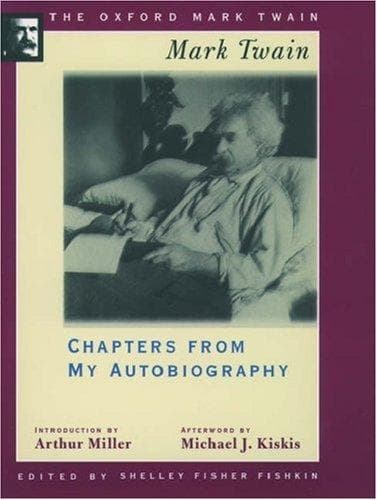
Authors, American -- 19th century -- Biography; Humorists, American -- 19th century -- Biography; Twain, Mark, 1835-1910
Papa's appearance has been described many times, but very
incorrectly. He has beautiful gray hair, not any too thick or any
too long, but just right; a Roman nose, which greatly improves the
beauty of his features; kind blue eyes and a small mustache. He has
a wonderfully shaped head and profile. He has a very good
figure--in short, he is an extrodinarily fine looking man. All his
features are perfect, except that he hasn't extrodinary teeth. His
complexion is very fair, and he doesn't ware a beard. He is a very
good man and a very funny one. He _has_ got a temper, but we all of
us have in this family. He is the loveliest man I ever saw or ever
hope to see--and oh, so absent-minded. He does tell perfectly
delightful stories. Clara and I used to sit on each arm of his
chair and listen while he told us stories about the pictures on the
wall.
I remember the story-telling days vividly. They were a difficult and
exacting audience--those little creatures.
Along one side of the library, in the Hartford home, the bookshelves
joined the mantelpiece--in fact there were shelves on both sides of the
mantelpiece. On these shelves, and on the mantelpiece, stood various
ornaments. At one end of the procession was a framed oil-painting of a
cat's head, at the other end was a head of a beautiful young girl,
life-size--called Emmeline, because she looked just about like that--an
impressionist water-color. Between the one picture and the other there
were twelve or fifteen of the bric-a-brac things already mentioned; also
an oil-painting by Elihu Vedder, "The Young Medusa." Every now and then
the children required me to construct a romance--always impromptu--not a
moment's preparation permitted--and into that romance I had to get all
that bric-a-brac and the three pictures. I had to start always with the
cat and finish with Emmeline. I was never allowed the refreshment of a
change, end-for-end. It was not permissible to introduce a bric-a-brac
ornament into the story out of its place in the procession.
These bric-a-bracs were never allowed a peaceful day, a reposeful day, a
restful Sabbath. In their lives there was no Sabbath, in their lives
there was no peace; they knew no existence but a monotonous career of
violence and bloodshed. In the course of time, the bric-a-brac and the
pictures showed wear. It was because they had had so many and such
tumultuous adventures in their romantic careers.
Public-domain text, read in full here on John Shaqi.
Reviews
Reviews
No reviews yet
Be the first to share your thoughts on this work.
Join the Discussion
Join the discussion
Sign in to leave a comment or review.
Sign InorCreate an account