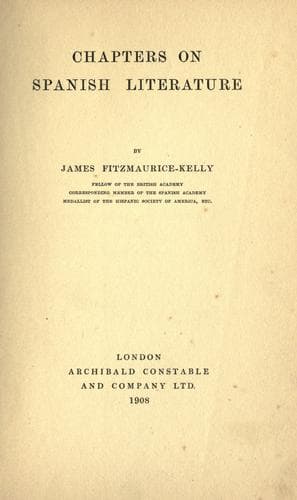
Chapters on Spanish LiteratureFitzmaurice-Kelly, James
History
Chapters on Spanish Literature
Fitzmaurice-Kelly, James
Spanish literature; Spanish literature -- History and criticism
Cervantes had now so unquestionably succeeded in prose that he was
tempted to bid for fame as a poet. He mistrusted his own powers, and,
as the event proved, with reason. His _Viage del Parnaso_, published
in 1614, commemorated the most prominent versifiers of the day in a
spirit of mingled appreciation and satirical criticism. It is very
doubtful whether there have been so many great poets in the history of
the world as Cervantes descried among his Spanish contemporaries, and
his compliments are too effusive and too universal to be effective. A
noble amateur, a potential patron, is lauded as extravagantly as though
he were the equal of Lope or Góngora, and the occasional excursions
into satire are mostly pointless. There are more wit, and pungency,
and concentrated force in any two pages of _English Bards and Scotch
Reviewers_ than in all the cantos of the _Viage del Parnaso_ put
together. It cannot be merely owing to temperamental differences that
Byron succeeds where Cervantes fails. There are splenetic passages in
the _Viage_ relating to such writers as Bernardo de la Vega and the
author of _La Pícara Justina_, but they miss their mark. The simple
truth is—not that Cervantes was willing to wound and yet afraid to
strike, but—that he had no complete mastery of his instrument.
His instinct was right; he moves uneasily in the fetters of verse, and
only becomes himself in the prose appendix to the _Viage_ which (as the
internal evidence discloses) was written side by side with the Second
Part of _Don Quixote_. His true vehicle was prose, but he was reluctant
to abide by the limitations of his genius, and while the sequel to _Don
Quixote_ was maturing, he produced a volume of plays containing eight
formal full-dress dramas and eight sparkling interludes. By sympathy
and by training Cervantes belonged to the older school of dramatists,
and his attempts to rival Lope de Vega on Lope’s own ground are mostly
embarrassed and, in some cases, curiously maladroit; yet he displays
a happy malicious humour in the less ambitious interludes, and, when
he betakes himself to prose, he captivates by the spontaneous wit
and nimble gaiety of his dialogue. These thumbnail sketches, like
the kit-cats of the _Novelas Exemplares_, may be regarded as so many
studies for the Second Part of _Don Quixote_, at which Cervantes was
still working.
Public-domain text, read in full here on John Shaqi.
Reviews
Reviews
No reviews yet
Be the first to share your thoughts on this work.
Elsewhere in the archive
Join the Discussion
Join the discussion
Sign in to leave a comment or review.
Sign InorCreate an account