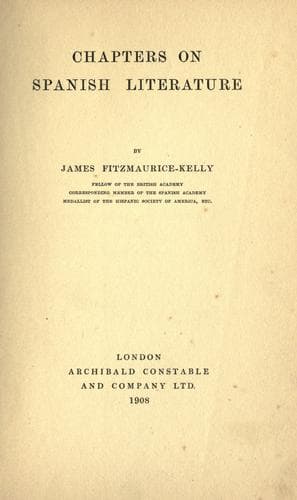
Chapters on Spanish LiteratureFitzmaurice-Kelly, James
History
Chapters on Spanish Literature
Fitzmaurice-Kelly, James
Spanish literature; Spanish literature -- History and criticism
One of the most attractive characteristics of _Don Quixote_ is its
maturity; it may not have taken more than three or four years to
write, but it embodies the experience of a lifetime, and it breathes
an air of urbanity and leisure. Cervantes was not an exceptionally
rapid writer, and—if he thought about the matter at all—probably knew
that masterpieces are seldom produced in a hurry. His great rival Lope
de Vega easily surpassed him in brilliant facility: Cervantes’s mind
was weightier, less fleet but more precise. In the closing sentences
of _Don Quixote_ he had half promised a continuation, and no doubt
it occupied his thoughts for many years. He had set himself a most
formidable task—the task of equalling himself at his best—and he may
well have shrunk from it, for he was risking his hard-won reputation
on a doubtful hazard. He was in no haste to put his fortune to the
touch. He sank into a pregnant silence, pondered over the technique
of his great design, and, with the exception of an occasional sonnet,
published nothing for eight years. At last in 1613 he issued his
_Novelas Exemplares_, twelve short stories, the composition of which
was spread over a long space of time. One of these, _Rinconete y
Cortadillo_, is mentioned in _Don Quixote_, and must therefore date
from 1602 or earlier; a companion story, the _Coloquio de los Perros_,
is assigned to 1608; and the remaining ten are plausibly believed to
have been written between these dates. The two tales just mentioned
are the gems of the collection, but _La Gitanilla_ and _El Celoso
extremeño_ are scarcely less striking, and certainly seven out of
the dozen are models of realistic art. Cervantes was never troubled
by mock-modesty, and ingenuously asserts that he was ‘the first to
attempt novels in the Castilian tongue, for the many which wander
about in print in Spanish are all translated from foreign languages,
while these are my own, neither imitated nor stolen.’ There were
earlier collections of stories (from one of which—Eslava’s _Noches
de Invierno_—Shakespeare contrived to borrow the plot of _The
Tempest_), but they are eclipsed by the _Novelas Exemplares_. These, in
their turn, are overshadowed by _Don Quixote_, but they would suffice
to make the reputation of any novelist by their fine invention and
engaging fusion of truth with fantasy. The harshest of native critics
yielded to the spell, and the _Novelas Exemplares_ were skilfully
exploited by John Fletcher and by Middleton and Rowley in England, as
well as by Hardy in France.
Public-domain text, read in full here on John Shaqi.
Reviews
Reviews
No reviews yet
Be the first to share your thoughts on this work.
Elsewhere in the archive
Join the Discussion
Join the discussion
Sign in to leave a comment or review.
Sign InorCreate an account