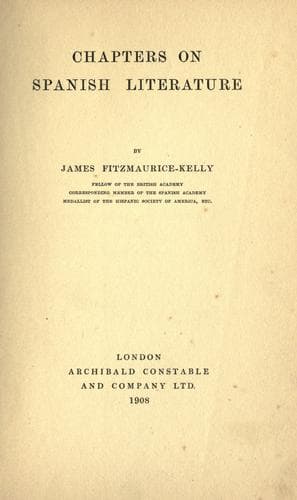
Chapters on Spanish LiteratureFitzmaurice-Kelly, James
History
Chapters on Spanish Literature
Fitzmaurice-Kelly, James
Spanish literature; Spanish literature -- History and criticism
The swelling tide of _culteranismo_ was invading the stage; the fatal
protection of Philip IV. was beginning to undermine the national
theatre. Lope had always opposed the new fashion of preciosity, and he
could not, or would not, supply the demand at court for a spectacular
drama. One could scarcely expect him to help in demolishing the work
of his lifetime. In his youth, and even in middle age, he looked down
upon his plays as being almost outside the pale of literature. He lived
long enough to revise his opinion, though perhaps to the last he would
have refused to admit that his plays were worth all his epics put
together. He lived long enough to revise his opinion, and a little too
long for his happiness. His latest plays did not hit the public taste:
his successor was already hailed in the person of the courtly Calderón
whom he himself had first praised. To his artistic mortifications were
added poignant domestic sorrows. He had dissuaded his son, Lope Félix,
from adopting literature as a profession: the youth joined the navy,
went on a cruise to South America, and was there
summoned to the deep.
He, he and all his mates, to keep
An incommunicable sleep.
The drowning of his son in 1634 was a grievous blow to Lope, but a more
cruel stroke awaited him. The flight of his favourite daughter, Antonia
Clara, from her home filled him with an unspeakable despair. He could
endure no more. With the simple, confiding faith that never left him,
he believed that his sins had brought upon him the vengeance of heaven,
and he sought to make tardy atonement by the severest penance, lashing
himself till the walls of his room were flecked with blood. But the end
was at hand. On August 23, 1635, Lope wrote his last two poems, fell
ill, and on August 27 his soul was required of him.
The extravagant and erring spirit hies
To his confine.
Headed by the Duke of Sesa, the vast funeral procession turned aside
so as to pass before the convent of the Barefooted Trinitarians where
Lope’s gifted daughter Marcela had taken the vows in 1621. From the
cloister window the nun watched the multitude on its way to the Church
of St. Sebastian in the Calle de Atocha; there, to the mournful music
of the _Dies irae_, Lope was interred beneath the high altar. His
eloquent lips were silent; his untiring hand and his unquiet heart were
still: his passionate pilgrimage was over. It might have been thought
that all that was mortal of him was at peace for ever, and that the
final resting-place of one so famous could not be forgotten. But, as
if to show that all is vanity, it was otherwise decreed by the mocking
fates. Early in the nineteenth century it became necessary to remove
Lope’s coffin from the vault in which it lay, and no care was taken
to ensure its subsequent identification. Hence he, whose renown once
filled the world, now sleeps unrecognised amid the humble and the
obscure.
Public-domain text, read in full here on John Shaqi.
Reviews
Reviews
No reviews yet
Be the first to share your thoughts on this work.
Elsewhere in the archive
Join the Discussion
Join the discussion
Sign in to leave a comment or review.
Sign InorCreate an account