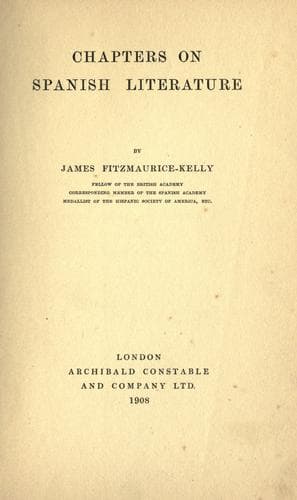
Chapters on Spanish LiteratureFitzmaurice-Kelly, James
History
Chapters on Spanish Literature
Fitzmaurice-Kelly, James
Spanish literature; Spanish literature -- History and criticism
It has been granted us to know Lope de Vega better than we know most
of our contemporaries. He lived in the merciless light of publicity;
his slightest slip was noted by vigilant eyes and rancorous pens; and
he has himself recorded the weaknesses which any other man would have
studiously concealed. Yet, gross as were his sins, his individual charm
is irresistible. Ruiz de Alarcón taxed him with being envious, and
from the huge mass of his confidential correspondence, a few detached
phrases are picked out to support this charge. None of us is as frank
as Lope; yet it seems highly probable that, if a selection were made
from the private letters written in this city to-day and this selection
were published in the newspapers to-morrow, a certain number of
personal difficulties might follow. But let us test Ruiz de Alarcón’s
charge. Of whom should Lope be envious? Not of Ruiz de Alarcón himself,
undoubtedly a remarkable dramatist, but never popular as Lope was. Not
of Tirso de Molina, another great dramatist, but a personal friend
of Lope’s. Not of Cervantes, who had abandoned the stage long before
he succeeded so greatly in romance. Not of Góngora, of whose poetic
principles Lope disapproved, but to whom he paid sedulous court. Not of
Calderón, who was nearly forty years younger than himself, and whom he
first presented to the public. The accusation has no more solid base
than a few choleric words dropped in haste.
The truth is that Lope is open to precisely the opposite charge
of culpable complaisance. His genius, like that of Cervantes, was
creative, not critical; his praise is fulsome, indiscriminating, and
therefore ineffective. He was a most loyal friend, and to him all his
geese are swans. His _Laurel de Apolo_ is an exercise in adulation
of no more critical value than Cervantes’s _Canto de Calíope_.
Famous writers, once in port, are inclined to ‘nurse’ their fame by
conciliating their rivals. Lope’s constant successes provided him with
so many foes that it would have been folly to increase their number by
attacking rising men. Like most other contemporaries he detested Ruiz
de Alarcón; but Ruiz de Alarcón could take very good care of himself in
a wrangle, and perhaps a man is not universally detested without some
good reason. Apart from any question of tactics, Lope was naturally
generous. There is a credible story that he dashed off the _Orfeo_ to
launch Pérez de Montalbán, who published it under his own name, and
thus started on a prosperous, feverish career.
Public-domain text, read in full here on John Shaqi.
Reviews
Reviews
No reviews yet
Be the first to share your thoughts on this work.
Elsewhere in the archive
Join the Discussion
Join the discussion
Sign in to leave a comment or review.
Sign InorCreate an account