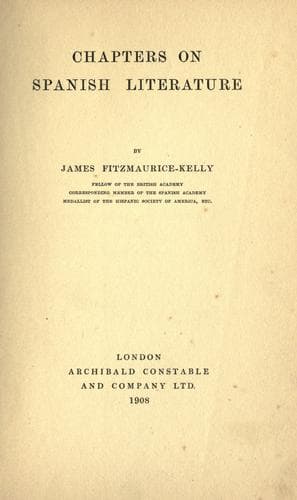
Chapters on Spanish LiteratureFitzmaurice-Kelly, James
History
Chapters on Spanish Literature
Fitzmaurice-Kelly, James
Spanish literature; Spanish literature -- History and criticism
Lope was a sad sinner, but any attempt to represent him as an unamiable
man is ridiculous. It is certain that he received large sums of money,
and that he died poor: his purse was open to all comers. He lived
frugally, loving nothing better than a romp with his children in the
garden of his little house in the Calle de Francos. His pleasures and
tastes were simple: careless remarks that drop from him reveal him to
us. Typical Spaniard as he was, he disliked bull-fights, but he loved
angling, and was a most enthusiastic gardener. He had, as he tells us
in his pleasant way, half a dozen pictures and a few books; but the
only extravagance which he allowed himself was the occasional purchase
of flowers rare in Spain. He had a passion for the tulip—at that time
a novelty in Europe—and, by dedicating to Manoel Soeiro his _Luscinda
perseguida_ (an early play, not printed till 1621), he handsomely
expressed his thanks for a present of choice Dutch bulbs. But, even
if such positive testimony were wanting, we should confidently guess
Lope’s tastes from his poems, redolent of buds and blossoms, of gardens
and of glades, of sweet perfumes and subtle aromas. In reading him, we
think inevitably of _The Flower’s Name_: you remember the lines, but I
may be allowed to quote them:—
This flower she stopped at, finger on lip,
Stooped over, in doubt, as settling its claim;
Till she gave me, with pride to make no slip,
Its soft meandering Spanish name;
What a name! was it love or praise?
Speech half-asleep, or song half-awake?
I must learn Spanish, one of these days,
Only for that slow sweet name’s sake.
It is very probable that Browning was not deeply read in the
masterpieces of Spanish literature, and that he knew comparatively
little of Lope; but in these verses we have (as it were) Lope rendered
into English: they are Lope all over.
No competent judge questions Lope de Vega’s right to rank as a great
poet, but scarcely any great poet—except perhaps Wordsworth—is so
unequal. The huge epics upon which he laboured so long, filing and
polishing every line, are now forgotten by all but specialists, and
(even among these elect) who can pretend that he reads the _Jerusalén
conquistada_ solely for pleasure? On the other hand, no unprejudiced
critic denies the beauty of Lope’s best sonnets and lyrics, nor the
natural grace of his prose in the _Dorotea_, and in his unguarded
correspondence. Had he written nothing else, he would be considered
a charming poet, and wonderfully versatile man of letters. But these
performances; astonishing as they are, may be regarded as the mere
diversions of exuberant genius.
Public-domain text, read in full here on John Shaqi.
Reviews
Reviews
No reviews yet
Be the first to share your thoughts on this work.
Elsewhere in the archive
Join the Discussion
Join the discussion
Sign in to leave a comment or review.
Sign InorCreate an account