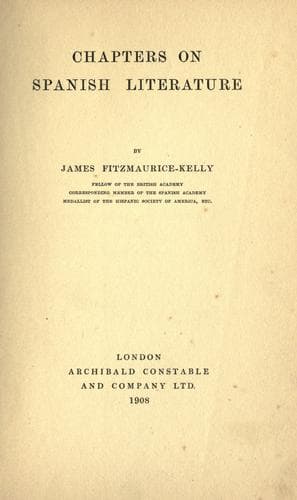
Chapters on Spanish LiteratureFitzmaurice-Kelly, James
History
Chapters on Spanish Literature
Fitzmaurice-Kelly, James
Spanish literature; Spanish literature -- History and criticism
The marvel is that such bungling has not been able to destroy the
beauty of his conception altogether. Dramatic conception, and the
faculty of distilling from no far-fetched situation all that it
contains, are Lope’s distinctive qualities. He is less successful in
maintaining a constant level of verbal charm; he can caress the ear
with an exquisite rhythmical cadence, but he hears the impresario
calling, sets spurs to Pegasus, and stumbles. The Nemesis of haste
pursues him, and, as has often been remarked, some of his last acts
are weak. _La batalla del honor_ is a case in point: a splendid play
spoiled by a weak ending. But this undeniable defect is not peculiar
to Lope de Vega: it is noticeable in _Julius Cæsar_, the last act of
which reveals Shakespeare pressed for time, and tacking his scenes
rapidly together so as to put the play punctually in rehearsal. Let us
be honest, and use the same scales and weights for every one: we shall
find the greatest works by the greatest men frequently come short of
absolute perfection at some point. Lope fails with the rest, and, if he
fails oftener, that is because he writes more. Is it surprising that he
should sometimes feel the strain upon him? He had not only to invent
plots by the score, and create character by the hundred: he had also to
satisfy a vigilant and fastidious public by the variety of his metrical
craftsmanship, and in this respect he has neither equal nor second.
We must accept Lope as Heaven made him with his inevitable
imperfections and his incomparable endowment. He has the Spanish
desire to shine, to be conspicuous, to please, and he condescends to
please at almost any cost. Yet he has an artistic conscience of his
own, endangers his supremacy by flouting the tribe of _cultos_, and
pours equal scorn on the pageant-plays—the _comedias del vulgo_ which
were so soon to become the fashion in court-circles. Lope needed no
scene-painters to make good his deficiencies. In _Ay verdades que en
amor_, he laughs at the pieces
en que la carpintería
suple concetos y trazas.
And well he might, for his alert presentation would convert a barn
into a palace. In the _comedia_ which he invented—using _comedia_ in
much the same sense as Dante uses _commedia_—his scope is unlimited:
he stages all ranks of human society from kings to rustic clowns, and
is by turns tragic, serious, diverting, pathetic, or gay. He has the
unique power of creating the daintiest heroines in the world—beautiful,
appealing, tender and brave. He has the secret of communicating
emotion, of inventing dialogue, always appropriate, and he is ever
prompt to enliven it with a delicate humour, humane and debonair.
He has not merely enriched Spain: in some degree not yet precisely
known—for the history of comparative literature is in its infancy—he
has contributed to almost every theatre in Europe.
Public-domain text, read in full here on John Shaqi.
Reviews
Reviews
No reviews yet
Be the first to share your thoughts on this work.
Elsewhere in the archive
Join the Discussion
Join the discussion
Sign in to leave a comment or review.
Sign InorCreate an account