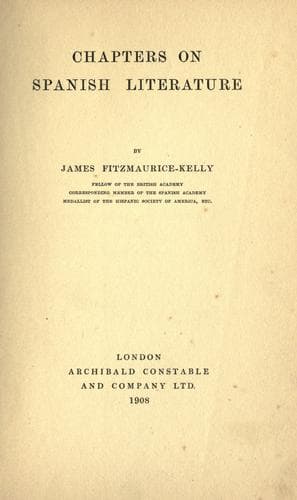
Chapters on Spanish LiteratureFitzmaurice-Kelly, James
History
Chapters on Spanish Literature
Fitzmaurice-Kelly, James
Spanish literature; Spanish literature -- History and criticism
Two or three illustrations must suffice. Rotrou, as the handbooks tell
us, has borrowed four—perhaps five—plays from Lope: we may now say five
and perhaps six, for in _Cosroès_ Lope’s _Las Mudanzas de la fortuna
y sucesos de don Beltrán de Aragón_ is combined with a Latin play by
Louis Cellot. Every one remembers that Corneille borrowed _Don Sanche
d’Aragon_ and the _Suite du Menteur_ from Lope. There are traces of
Lope in Molière: in _Les Femmes savantes_, in _L’École des maris_,
in _L’École des Femmes_, in _Le Médecin malgré lui_—and perhaps in
_Tartufe_. And, even in the present incomplete state of our knowledge,
it would be possible to draw up a long list of foreign debtors from
Boisrobert and D’Ouville to Lesage. Of Lope’s Spanish imitators this
is not the time to speak. He did not found a school, but every Spanish
dramatist of the best period marches under Lope’s flag. There are still
some who, in a spirit of chicane, would withhold from him the glory of
being the architect of the Spanish theatre. So be it: but even they
acknowledge that he found it brick, and left it marble.
CHAPTER VIII
CALDERÓN
For some time before Lope de Vega’s death, it was evident that Calderón
would succeed him as dictator of the stage. There was no serious
competitor in sight. Tirso de Molina was becoming rusty; Vélez de
Guevara and Ruiz de Alarcón, both on the wrong side of fifty when
Lope died, had given the measure of what they could do, and Ruiz de
Alarcón’s art was too individual to be popular. No possible rival to
Calderón was to be found among the younger men. His path lay smooth
before him. He developed the national drama which Lope had created; he
accentuated its characteristics, but introduced no radical innovation.
He found the most difficult part of the work already done; he inherited
a vast intellectual estate, and it is the general opinion that the
patronage of Philip IV. helped him to exploit it profitably. This point
may stand over for the moment. Here and now, it is enough to say that
Calderón’s career, so far as we can trace it, was one of uninterrupted
success. Unfortunately, at present, we can only sketch his biography
in outline. Within a year of his death, a short life of him was
published by his admirer and editor, Juan de Vera Tassis y Villarroel;
but, as Vera Tassis was thirty or forty years younger than Calderón,
he naturally knew nothing of the dramatist’s early circumstances. He
begins badly with a blunder as to the date of Calderón’s birth, shows
himself untrustworthy in matters of fact, and indulges too freely in
flatulent panegyric. For the present we are condemned to make bricks
with only a few wisps of straw; but if, as seems likely, Dr. Pérez
Pastor is as fortunate with Calderón as he was with Cervantes, many a
blank will be filled in before long.
Public-domain text, read in full here on John Shaqi.
Reviews
Reviews
No reviews yet
Be the first to share your thoughts on this work.
Elsewhere in the archive
Join the Discussion
Join the discussion
Sign in to leave a comment or review.
Sign InorCreate an account