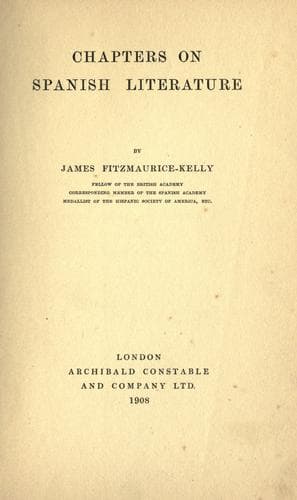
Chapters on Spanish LiteratureFitzmaurice-Kelly, James
History
Chapters on Spanish Literature
Fitzmaurice-Kelly, James
Spanish literature; Spanish literature -- History and criticism
Pedro Calderón de la Barca was born at Madrid on January 17, 1600.
He became an orphan at an early age. His mother, who was of Flemish
origin, died in 1610; his father, who was Secretary of the Council
of the Treasury, seems to have offended his first wife’s family by
marrying again, was excluded from administering a chaplaincy in their
gift, and died in 1615. Calderón was educated at the Jesuit college
in Madrid, and later studied theology at the University of Salamanca
with a view to holding the family living; but he gave up his idea of
entering the Church, and took to literature. It has been said that he
collaborated with Rojas Zorrilla and Belmonte in writing _El mejor
amigo el muerto_, and he is specifically named as being the author of
the Third Act. On the other hand, it is asserted that _El mejor amigo
el muerto_ was played on Christmas Eve, 1610, and, if this be so, we
must abandon the ascription, for Calderón was then a boy of ten, while
Rojas Zorrilla was only three years old. We may also hesitate to accept
the unsupported statement of Vera Tassis that Calderón wrote _El Carro
del Cielo_ at the age of thirteen. Such ‘fond legends of their infancy’
accumulate round all great men. So far as can be gathered, Calderón
first came before the public in 1620-22 at the literary _fêtes_ held at
Madrid in honour of St. Isidore, the patron saint of the city; and on
the latter occasion Lope de Vega, who was usually florid in compliment,
welcomed the new-comer as one who ‘in his youth has gained the laurels
which time, as a rule, only grants together with grey hair.’ From the
date of these first triumphs onward, Calderón never went back.
In 1621, four years before reaching his legal majority, he was granted
letters-patent to administer his estate. Vera Tassis asserts that
Calderón entered the army in 1625, and that he served in Milan and
Flanders. If so, his service must have been very short, for he was
at Madrid on September 11, 1625, and was still residing in that city
on April 16, 1626. We find him again at Madrid, and in a scrape, in
January 1629. His brother, Diego, had been stabbed by the actor Pedro
de Villegas, who took sanctuary in the convent of the Trinitarian
nuns; Calderón and his backers determined to seize the culprit, broke
into the cloister, handled the nuns roughly, dragged off their veils,
and used strong language to them. Such conduct is very unlike all
that we know of Calderón; but this was the current version of his
proceedings, and the rumour fluttered the dovecots of the devout. The
alleged misdeeds of Calderón and his friends were denounced by the
fashionable preacher, Hortensio Félix Paravicino, in a sermon delivered
before Philip IV. on January 11, 1629. Calderon retaliated by making a
sarcastic reference in _El Príncipe constante_ to the popular ranter’s
habit of spouting unintelligible jargon:—
Public-domain text, read in full here on John Shaqi.
Reviews
Reviews
No reviews yet
Be the first to share your thoughts on this work.
Elsewhere in the archive
Join the Discussion
Join the discussion
Sign in to leave a comment or review.
Sign InorCreate an account