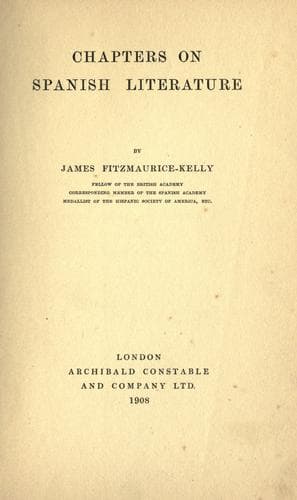
Chapters on Spanish LiteratureFitzmaurice-Kelly, James
History
Chapters on Spanish Literature
Fitzmaurice-Kelly, James
Spanish literature; Spanish literature -- History and criticism
It is a fact that the earliest extant French _chanson de geste_ was
in existence a century before the earliest extant Spanish _cantar de
gesta_: it is also a fact that the French version of Roland’s story was
widely diffused in Spain at an early date. It was there recorded in the
forged chronicle ascribed to Archbishop Turpin, and it filtered down to
the masses who heard it from French pilgrims on the road to the shrine
of St. James at Santiago de Compostela. Among these pilgrims were
French _trouvères_, and through them the Spaniards became acquainted
with the _Chanson de Roland_. It was natural that suggestion should
operate in Spain as it operated in Germany, where Konrad produced
his _Rolandslied_ about the year 1130. There is at least a strong
presumption that the author of the _Poema del Cid_ had heard the
_Chanson de Roland_. Sr. Menéndez y Pelayo, whose patriotism and fine
literary sense make him a witness above suspicion, admits that there
is a marked resemblance between the battle-scenes in the two poems,
and further allows that there are cases of verbal coincidence which
cannot be accidental. We may therefore agree with Gaston Paris that the
author of the _Poema del Cid_ found his inspiration in the _Chanson de
Roland_: that is to say, the _Chanson_ probably suggested to him the
idea of composing a similar work on a Spanish theme, and gave him a
few secondary details. We cannot say less, nor more: except that in
subject and sentiment the _Poema_ is intensely local.
As regards its substance, the _Poema_ is intermediate between history
and fable. There is no respect for chronology; one personage is
mistaken for a namesake; the Cid’s daughters, whose real names were
Cristina and María, are called Elvira and Sol, and are provided with
husbands to whom they were never married in fact, but who may have been
maliciously introduced (as Dozy surmised) to exhibit the Leonese in
an odious light. It is the office of an epic poet to exalt his hero,
and to belittle that hero’s enemies; you might as reasonably look for
perfect execution in the _Poema del Cid_ as for judicial impartiality.
Apart from freaks which may be due to bad copying, we accept the fact
that the metre is capricious, fluctuating between lines of fourteen and
sixteen syllables: we must also accept the fact that history fares no
better than metre, and often fares worse. Yet the spirit of the poet is
not consciously unhistorical; he conveys the impression of believing in
the truth of his own story. There is an accent of deep sincerity from
the outset, in what—owing to mutilation—is now the beginning of the
_Poema_, a passage recording the exile of the Cid:—
Public-domain text, read in full here on John Shaqi.
Reviews
Reviews
No reviews yet
Be the first to share your thoughts on this work.
Join the Discussion
Join the discussion
Sign in to leave a comment or review.
Sign InorCreate an account