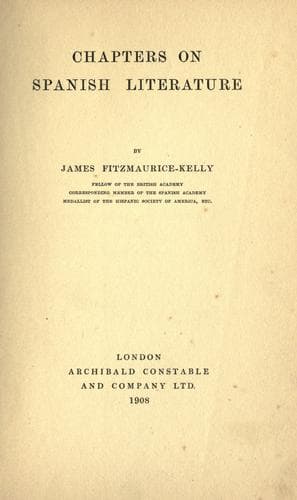
Chapters on Spanish LiteratureFitzmaurice-Kelly, James
History
Chapters on Spanish Literature
Fitzmaurice-Kelly, James
Spanish literature; Spanish literature -- History and criticism
He fails at the point where the convention is weakest. His _graciosos_
or drolls are too laboriously comic to be amusing. He has abundant
wit, and the _discreteo_ of the lover and the lady is often brilliant.
But there is some foundation for the taunt that he is interested only
in fine gentlemen and _précieuses_. He had not lived in courts and
palaces for nothing. The racy, rough humour of the illiterate clearly
repelled his fastidious temper, and the fun of his _graciosos_ is
unreal. This is what might be anticipated. It takes one cast in the
mould of Shakespeare, or Cervantes, or Lope, to sympathise with all
conditions of men. Calderón fails in another point, and the failure
is certainly very strange in a man of his meticulous refinement and
social opportunities. With few exceptions, the women in his most famous
plays are unattractive. A Spanish critic puts it strongly when he
calls the women on Calderón’s stage _hombrunas_ or mannish. No foreign
critic would be brave enough to say this, but it is not an unfair
description. A man’s idea of a womanly woman is often quaint: he sees
her as something between a white-robed angel and a perfect imbecile.
That is not Calderón’s way. Doña Mencía in _El Médico de su honra_ and
Doña Leonor in _Á secreto agravio secreta venganza_ are distinctly
formidable, and, even in the cloak-and-sword plays, there is something
masculine in the academic preciosity of the lively heroines. It is
manifest that Calderón has no deep knowledge of feminine character,
that his interest in it is assumed for stage purposes, and that his
chief preoccupation is—not to portray idiosyncrasies, nor even types
of womanhood, but—to make physical beauty the theme of his eloquent,
poetic flights. In this he succeeds admirably, though his flights are
apt to be too long. You probably know Suppico de Moraes’ story of
Calderón’s acting before Philip IV. in an improvisation at the Buen
Retiro, the poet taking the part of Adam, and Vélez de Guevara that of
God the Father. Once started, Calderón declaimed and declaimed, and,
when he came to an end at last, Vélez de Guevara took up the dialogue
with the remark: ‘I repent me of creating so garrulous an Adam!’ Most
probably the tale is an invention,[104] but it is not without point,
for Philip and the rest would have been a match for Job, if they had
never been bored with the favourite’s tirades. Like most Spaniards,
Calderón is too copious; but in lyrical splendour he is unsurpassed by
any Spanish poet, and is surpassed by few poets in any language. Had he
added more frequent touches of nature to his idealised presentations,
he would rank with the greatest dramatists in the world.
Public-domain text, read in full here on John Shaqi.
Reviews
Reviews
No reviews yet
Be the first to share your thoughts on this work.
Elsewhere in the archive
Join the Discussion
Join the discussion
Sign in to leave a comment or review.
Sign InorCreate an account