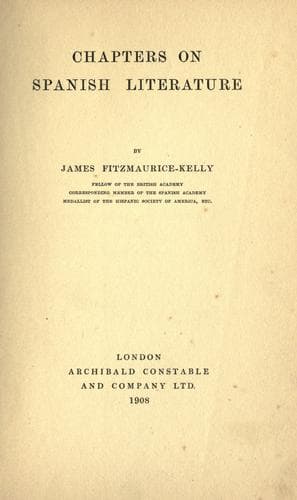
Chapters on Spanish LiteratureFitzmaurice-Kelly, James
History
Chapters on Spanish Literature
Fitzmaurice-Kelly, James
Spanish literature; Spanish literature -- History and criticism
As it is, he ranks only just below the greatest, and in one dramatic
form peculiar to Spain, he is, by common consent, supreme. Everybody
quotes Shelley’s phrase about ‘the light and odour of the starry
_autos_’; but scarcely anybody reads the _autos_, and I rather doubt if
Shelley read them. It is suggested that he took an _auto_ to mean an
ordinary play, and this seems likely enough, for that is what an _auto_
did mean at one time. But an _auto sacramental_ in Calderón’s time was
a one-act piece (performed in the open air on the Feast of Corpus
Christi) in which the Eucharistic mystery was presented symbolically.
We can imagine this being done successfully two or three times, but not
oftener. The difficulty was extreme, and as a new _auto_—usually two
new _autos_—had to be provided every year, authors had recourse to the
strangest devices. There are _autos_ in which Christ is symbolised by
Charlemagne (surrounded by his twelve peers), or by Jason, or Ulysses;
there are _autos_ in which an attempt is made to evade the conditions
by introducing saints famous for their devotion to the Eucharist. Such
pieces are illegitimate: they are not really _autos sacramentales_, but
_comedias devotas_.
Calderón treats the subject within the rigid limits of the
convention,—as a doctrinal abstraction,—and he treats it in a spirit
of the most reverential art. He does not fail even in _El Valle de
la Zarzuela_, where he hampers himself by connecting the theme with
one of Philip IV.’s hunting-expeditions. He tells us with a certain
dignified pride that his _autos_ had been played before the King and
Council for more than thirty years, and he apologises for occasional
repetitions by saying that these are not so noticeable at a distance
of twenty years as when they occur between the covers of a book. But
no apology is needed. Calderón dealt with his abstruse theme more
than seventy times—not always with equal success, but never quite
unsuccessfully, and never repeating himself unduly. This is surely one
of the most dexterous exploits in literature, and Calderón appears to
have done it with consummate ease. His reflective genius, steeped in
dogma, was far more interested in the mysteries of faith than in the
passions of humanity, far more interested in devout symbolism than in
realistic characterisation. His figures are pale abstractions? Yes: but
he compels us to accept them by virtue of his sublime allegory, his
majestic vision of the world invisible, and the adorable loveliness of
his lyrism.
Public-domain text, read in full here on John Shaqi.
Reviews
Reviews
No reviews yet
Be the first to share your thoughts on this work.
Elsewhere in the archive
Join the Discussion
Join the discussion
Sign in to leave a comment or review.
Sign InorCreate an account