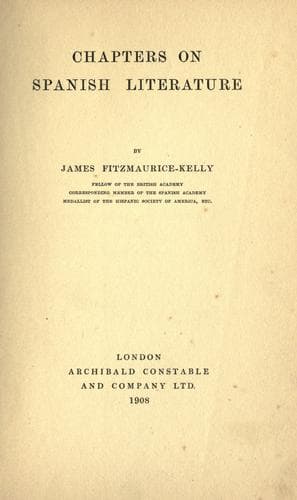
Chapters on Spanish LiteratureFitzmaurice-Kelly, James
History
Chapters on Spanish Literature
Fitzmaurice-Kelly, James
Spanish literature; Spanish literature -- History and criticism
All Spanish dramatists of this period came under Lope’s influence. He
was even more supreme in Madrid than in Valencia, and other provincial
centres. He set the fashion to men as considerable as Vélez de Guevara,
Mira de Amescua, Tirso de Molina, and Calderón himself. Lope and Ruiz
de Alarcón were at daggers drawn; but these were personal quarrels,
and, original as was Alarcón’s talent, the torch of Lope flickers over
some of his best scenes. These men were much more than imitators. If
Lope ever had a devoted follower, it was the unfortunate Juan Pérez
de Montalbán; but even Pérez de Montalbán was not a servile imitator,
and it was precisely his effort to develop originality that affected
his reason. Lope’s influence was general; he founded a national drama,
but he founded nothing which we can justly call a school—a word which
implies a certain exclusiveness and rigidity of doctrine foreign to
Lope’s nature. So far was he from founding a school that, towards the
end of his life, he was voted rather antiquated, and this view was
still more widely held during Calderón’s supremacy. In the autograph
of Lope’s unpublished play, _Quien más no puede_, there is a note by
Cristóbal Gómez, who writes—‘This is a very good play, but not suitable
for these times, though suitable in the past; for it contains many
_endechas_ and many things which would not be endured nowadays; the
plot is good, and should be versified in the prevailing fashion.’ This
is dated April 19, 1669, less than forty years after Lope’s death; he
was beginning to be forgotten by almost all, except the playwrights who
stole from him.
Calderón, on the other hand, did found a school. For one thing, his
conventionality and mannerisms are infinitely easier to imitate than
Lope’s broad effects. ‘Spanish Comedy,’ as Mr. George Meredith says,
‘is generally in sharp outline, as of skeletons; in quick movement, as
of marionettes. The Comedy might be performed by a troupe of the _corps
de ballet_; and in the recollection of the reading it resolves to an
animated shuffle of feet.’ Whatever we may think of this as a judgment
on Spanish comedy as a whole, it describes fairly enough the dramatic
work produced by many of Calderón’s followers: with them, if not with
their master, art degenerates into artifice—a clever trick. Calderón
himself seems to have grown tired of the praises lavished on his
ingenuity. He knew perfectly that neatness of construction was not the
best part of his work, and, in _No hay burlas con el amor_, he laughs
at himself and his more uncritical admirers:—
¿Es comedia de don Pedro
Calderón, donde ha de haber
por fuerza amante escondido,
ó rebozada muger?
Public-domain text, read in full here on John Shaqi.
Reviews
Reviews
No reviews yet
Be the first to share your thoughts on this work.
Elsewhere in the archive
Join the Discussion
Join the discussion
Sign in to leave a comment or review.
Sign InorCreate an account