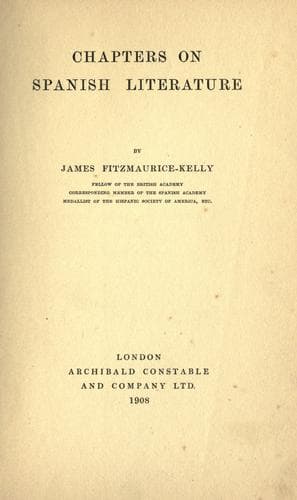
Chapters on Spanish LiteratureFitzmaurice-Kelly, James
History
Chapters on Spanish Literature
Fitzmaurice-Kelly, James
Spanish literature; Spanish literature -- History and criticism
Unfortunately these stage devices—these concealed lovers, these
muffled mistresses, these houses with two doors, these walls with
invisible cupboards, these compromising letters wrongly addressed—were
precisely what appealed to the unthinking section of the public, and
they were also the characteristics most easily reproduced by imitators
in search of a short cut to success. Other circumstances combined to
make Calderón the head of a dramatic school. Except in invention and
in brilliant facility the dramatists of Lope’s time were not greatly
inferior to the master. In certain qualities Tirso de Molina and
Ruiz de Alarcón are superior to him: Tirso in force and in malicious
humour, Ruiz de Alarcón in depth and in artistic finish. There is no
such approach to equality between Calderón and the men of his group.
No strikingly original dramatic genius appeared during his long life,
extending over three literary generations. He himself had made no new
departure, no radical innovation; he took over the dramatic form as
Lope had left it, and, by focussing its common traits, he established
a series of conventions—a conventional conception of loyalty, honour,
love and jealousy. The stars in their courses fought for him. He was
equally popular at court and with the multitude, pleasing the upper
rabble by his glittering intrigue and dexterous _discreteo_, pleasing
the lower rabble by his melodramatic incident and the mechanical humour
of his _graciosos_, pleasing both high and low by his lofty Catholicism
and passionate devotion to the throne. Though not in any real sense
more Spanish than Lope de Vega, Calderón seems to be more intensely
national, for he reduced the _españolismo_ of his age to a formula. Out
of the plays of Lope and of Tirso, he evolved a hard-and-fast method
of dramatic presentation. He came at a time when it was impossible to
do more. All that could be done by those who came after him was to
emphasise the convention which, by dint of constant repetition, he had
converted into something like an imperative theory.
Public-domain text, read in full here on John Shaqi.
Reviews
Reviews
No reviews yet
Be the first to share your thoughts on this work.
Elsewhere in the archive
Join the Discussion
Join the discussion
Sign in to leave a comment or review.
Sign InorCreate an account