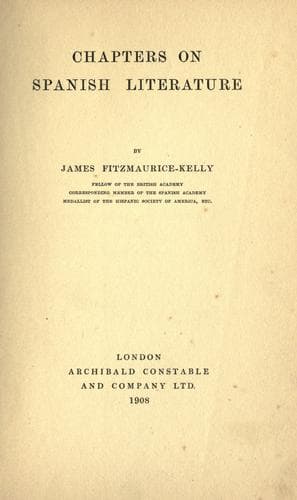
Chapters on Spanish LiteratureFitzmaurice-Kelly, James
History
Chapters on Spanish Literature
Fitzmaurice-Kelly, James
Spanish literature; Spanish literature -- History and criticism
One is always reluctant to spoil a good story, but luck is against me
this afternoon. A few moments ago I mentioned the ‘Calderona,’ and
stated that she returned to the stage after her rupture with Philip
IV.: that destroys the usual picturesque story of her throwing herself
in an agony of abjection at Philip’s feet, and going straightway into a
convent to do penance for the rest of her life. I am afraid that I must
also destroy this agreeable legend about Moreto’s being a murderer.
It is unfortunate for Moreto, for many who have no strong taste for
literature are often induced to take interest in a man of letters if
he can be proved guilty of some crime: they will spell out a little
Old French because they have heard that Villon was a cracksman. Well,
we must tell the truth, and take the consequences. The identification
of the Pradillo del Carmen turns out to be wrong. The Pradillo del
Carmen was the cemetery used for those who died in the hospital to
which Moreto was chaplain, and to which he bequeathed his fortune:
the Pradillo del Carmen has nothing to do with the burial-place for
criminals, though it lies close by. Moreto evidently wished not to be
separated in death from the poor people amongst whom he had laboured;
but, as it happens, his directions were not carried out, for when he
died on December 28, 1669, he was buried in the church of St. John the
Baptist at Toledo. And this is not the only weak point in the story.
Medinilla was killed in 1620 when Moreto was two years old, and few
assassins, however precocious, begin operations at that tender age.
Lastly, it would seem that Medinilla was perhaps not murdered at all,
but was killed in fair fight by Jerónimo de Andrade y Rivadeneyra.
These prosaic facts compel me to present Moreto to you—not as an
interesting cut-throat, not as a morose and sinister murderer, crushed
by his dreadful secret, but—as a man of the most genial disposition,
noble character, and singularly virtuous life.
He was all this, and he was also one of the cleverest craftsmen who
ever worked for the Spanish stage. But nature does not shower all her
gifts on any one man, and she was niggardly to Moreto in the matter
of invention. He made no secret of the fact that he took whatever he
wanted from his predecessors. His friend Jerónimo de Cáncer represents
him as saying:—
Que estoy minando imagina
cuando tu de mí te quejas;
que en estas comedias viejas
he hallado una brava mina.
Public-domain text, read in full here on John Shaqi.
Reviews
Reviews
No reviews yet
Be the first to share your thoughts on this work.
Elsewhere in the archive
Join the Discussion
Join the discussion
Sign in to leave a comment or review.
Sign InorCreate an account