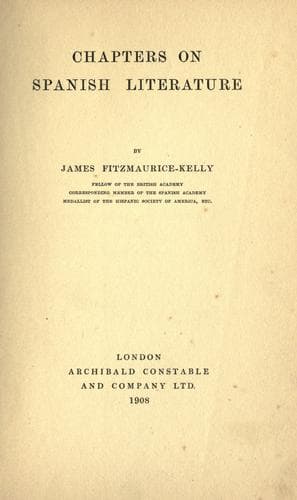
Chapters on Spanish LiteratureFitzmaurice-Kelly, James
History
Chapters on Spanish Literature
Fitzmaurice-Kelly, James
Spanish literature; Spanish literature -- History and criticism
He did, indeed, find a _brava mina_ in the old plays, and especially
in Lope de Vega’s. From Lope’s _El Gran Duque de Moscovia_ he takes _El
Príncipe perseguido_; from Lope’s _El Prodigio de Etiopia_ he takes
_La Adúltera penitente_; from Lope’s _El Testimonio vengado_ he takes
_Como se vengan los nobles_; from Lope’s _Las Pobrezas de Rinaldo_ he
takes _El Mejor Par de los doce_; from Lope’s _De cuando acá nos vino_
... he takes _De fuera vendrá quien de casa nos echará_; from Lope’s
delightful play _El Mayor imposible_ he constructs the still more
delightful _No puede ser_, from which John Crowne, at the suggestion of
Charles _II._, took his _Sir Courtly Nice, or, It cannot be_, and from
which Ludvig Holberg, the celebrated Danish dramatist, took his _Jean
de France_. Moreto was scarcely less indebted to Lope’s contemporaries
than to Lope himself. From Vélez de Guevara’s _El Capitán prodigioso
y Príncipe de Transilvania_ he took _El Príncipe prodigioso_; from
Guillén de Castro’s _Las Maravillas de Babilonia_ he took _El bruto de
Babilonia_, and from Castro’s _Los hermanos enemigos_ he took _Hasta el
fin nadie es dichoso_; from Tirso de Molina’s _La Villana de Vallecas_
he took _La ocasion hace al ladrón_; and from a novel of Castillo
Solórzano’s he took the entire plot of _La Confusion de un jardín_.
This is a fairly long list, but it does not include all Moreto’s debts.
He has his failures, of course. _El ricohombre de Alcalá_ looks anæmic
beside its original. _El Infanzón de Illescas_, which is ascribed to
both Lope and Tirso; and _Caer para levantar_ is a wooden arrangement
of Mira de Amescua’s striking play, _El Esclavo del demonio_. If you
can filch to no better purpose than this, then decidedly honesty is
the best policy. Perhaps Moreto came to this conclusion himself in
some passing mood, and it must have been at some such hour that he
wrote _El Parecido en la Corte_ and _Trampa adelante_, both abounding
in individual humour. But such moods are not frequent with him. If
you choose to say that Moreto was a systematic plagiarist, it is
hard for me to deny it. Every playwright of this period plagiarised
and pilfered, more or less, from Calderón downwards: we must accept
this as a fact—a fact as to which there was seldom any concealment.
Just as Moreto was drawing towards the end of his career as dramatist,
a most intrepid plagiarist arose in the person of Matos Fragoso, of
whom I shall have a word to say presently. But Matos Fragoso was sly,
and a bungler: Moreto was frank, and a master of the gentle art of
conveyance. He pilfers in all directions; but he manipulates the stolen
goods almost out of recognition, usually adding much to their value.
And this implies the possession of remarkable talent. In literature, as
in politics, if he can only contrive to succeed, a man is pardoned for
proceedings which in other callings might lead to jail: and Moreto’s
success is triumphant. The germ of his play, _El lindo Don Diego_,
Public-domain text, read in full here on John Shaqi.
Reviews
Reviews
No reviews yet
Be the first to share your thoughts on this work.
Elsewhere in the archive
Join the Discussion
Join the discussion
Sign in to leave a comment or review.
Sign InorCreate an account