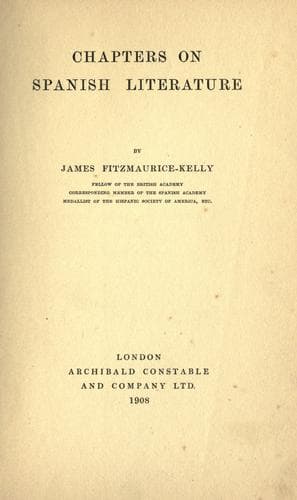
Chapters on Spanish LiteratureFitzmaurice-Kelly, James
History
Chapters on Spanish Literature
Fitzmaurice-Kelly, James
Spanish literature; Spanish literature -- History and criticism
No doubt the _Poema del Cid_ is very unequal. Too often it degenerates
into tracts of arid prose divided into lines of irregular length
with a final monotonous assonance: there are too many deserts dotted
with matter-of-fact details, names of insignificant places, and the
like. But the poet recovers himself, glows with local patriotism
when recording a gallant feat, and humanises his story with traits of
gentler sympathy—as when describing the parting of the Cid from Jimena
and his daughters at the monastery of San Pedro de Cardeña. And the
Spanish _juglar_ has the faculty of rapid, dramatic presentation. His
secondary personages are made visible with a few swift strokes—the
learned Bishop Jerónimo who, attracted by the Cid’s fame as a fighter,
comes from afar (‘de parte de orient’), and would almost as soon miss
a Mass as a battle with the Moors; the grim Alvar Fáñez, the Cid’s
right arm, his ‘diestro braço’ as Roland was Charlemagne’s ‘destre
braz’; the Cid’s nephew, Félez Muñoz, always at the post of danger; the
stolid, inscrutable Pero Bermuez, the standard-bearer whose habitual
muteness is transformed into eloquent invective when the hour comes
for denouncing the poltroonery of the Infantes of Carrión; and even
these fictitious rascals have an air of plausibility and life. In the
_Poema del Cid_ we meet for the first time with that forcible realistic
touch, that alert vision, that intense impression of the thing seen and
accurately observed which give to Spanish literature its peculiar stamp
of authenticity. And the poem ends on an exultant note with a pæan over
the defeat of the imaginary Infantes of Carrión, the really historical
betrothal of the Cid’s daughters, and the triumphant passing of the
Cid, reconciled to the King:—
And he that in a good hour was born, behold how he hath sped!
His daughters now to higher rank and greater honour wed:
Sought by Navarre and Aragon for queens his daughters twain!
And monarchs of his blood to-day upon the throne of Spain.
And so his honour in the land grows greater day by day.
Upon the feast of Pentecost from life he passed away.
For him and all of us the grace of Christ let us implore.
And here ye have the story of my Cid Campeador.
Public-domain text, read in full here on John Shaqi.
Reviews
Reviews
No reviews yet
Be the first to share your thoughts on this work.
Join the Discussion
Join the discussion
Sign in to leave a comment or review.
Sign InorCreate an account