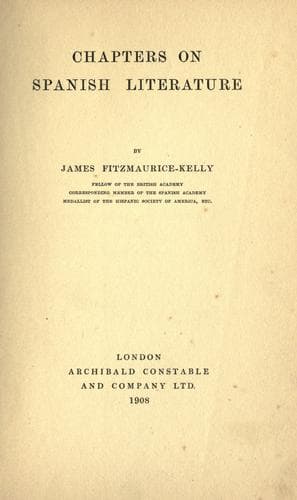
Chapters on Spanish LiteratureFitzmaurice-Kelly, James
History
Chapters on Spanish Literature
Fitzmaurice-Kelly, James
Spanish literature; Spanish literature -- History and criticism
While the War of Independence was in progress men were otherwise
engaged than in novel-reading, and in Ferdinand VII.’s reign literature
was apt to be a perilous trade. The banishment or flight of almost
every Spaniard of liberal opinions or intellectual distinction had
one result which might have been foreseen, if there had been a
clear-sighted man in the reactionary party. It brought to an end
the period of cut-and-dry classical domination. The exiles returned
with new ideals in literature as well as in politics. There was a
restless ferment of the libertarian, romantic spirit. Interest revived
in the old national romantic drama which had fallen out of fashion,
and had been known chiefly in recasts of a few stock pieces. Quaint
signs of change are discernible in unexpected quarters. When the
termagant Carlota, the Queen’s sister, snatched a state-paper out of
Calomarde’s hands and boxed his ears soundly, the crafty minister put
the affront aside by wittily quoting the title of one of Calderón’s
plays: ‘_Las manos blancas no ofenden_.’ Fifteen years earlier he
would probably have quoted from some wretched playwright like Comella.
French books were still eagerly read, but they were not ‘classical’
works. Chateaubriand and Bernardin de Saint-Pierre became available
in translations. Joaquín Telesforo de Trueba y Cosío, a _montañés_
residing in London, came under the spell of Walter Scott, and had the
courage to write two historical romances in English: I have read many
worse novels than _Gomez Arias_ and _The Castilians_, and every day
I see novels written in much worse English. The shadow of Scott was
projected far and wide over Spain, and those who read _The Bride of
Lammermoor_ usually went on to read _Notre-Dame de Paris_. If Scott
had never written historical novels, and if Ferdinand VII. had not
made many excellent Spaniards feel that they were safer anywhere than
in Spain, we should not have had Espronceda’s _Sancho Saldaña ó El
Castellano de Cuéllar_, nor Martínez de la Rosa’s Doña Isabel de Solís,
nor perhaps even Enrique Gil’s much more engaging story, _El Señor
de Bembibre_, which appeared in 1844. The first two are unsuccessful
imitations of Scott, and _El Señor de Bembibre_ is charged with
reminiscences of _The Bride of Lammermoor_.
Public-domain text, read in full here on John Shaqi.
Reviews
Reviews
No reviews yet
Be the first to share your thoughts on this work.
Elsewhere in the archive
Join the Discussion
Join the discussion
Sign in to leave a comment or review.
Sign InorCreate an account