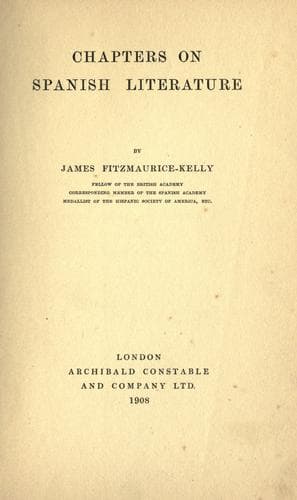
Chapters on Spanish LiteratureFitzmaurice-Kelly, James
History
Chapters on Spanish Literature
Fitzmaurice-Kelly, James
Spanish literature; Spanish literature -- History and criticism
It is one of life’s little ironies that the first writer of this period
to give us a genuinely Spanish story was not a writer of pure Spanish
origin. Fernán Caballero, as she chose to call herself,—and as it is
most convenient to call her, for she was married thrice, and therefore
used four different legal signatures, apart from her pseudonym,—was
the daughter of Johann Nikolas Böhl von Faber, who settled in Spain
and did useful journeyman’s work in literature. Born and partly
educated abroad, with a German father and a Spanish mother, it is not
surprising that she had the gift of tongues, and that one or two of
her early stories should have been originally written in French or in
German. Yet nothing could be less French or German than _La Gaviota_,
which appeared four years after _El Señor de Bembibre_ in a Spanish
version said (apparently on good authority) to be by Joaquín de Mora.
But, though Mora may be responsible for the style, nobody has ever
supposed that he was responsible for the matter, and any such theory
would be absurd, considering that Fernán Caballero wrote many similar
tales long after Mora’s death. In _La Gaviota_, in _La Familia de
Albareda_, in the _Cuadros de costumbres_, and the rest—transcriptions
of the simplest provincial customs, long since extirpated from the
soil in which they seemed to be irradicably implanted—there is for us
nowadays an historical interest; but there is nothing historical about
them: they are records of personal observation. Fortunately for herself
Fernán Caballero, who had no elaborate learning, did not attempt any
reconstruction of the past, and was mostly content to note what she
saw around her. In this sense she may be considered as a pioneer in
realism. The title would probably not have pleased her, owing to the
connotation of the word ‘realism’; but nevertheless she belongs to the
realistic school, and she expressly admits that she describes instead
of inventing. To prevent any possible misapprehension, it should be
said at once that her realism is gentle, peaceful and demure. She had
some small pretensions of her own, felt a mistaken vocation to do good
works among the heathen, and to be a trumpeter of orthodoxy. Each
of us is convinced, of course, that orthodoxy is his doxy, and that
heterodoxy is other people’s doxy; but Fernán Caballero’s insistence
has a self-righteous note which may easily grow tiresome. There are
some who find pleasure in her exhortations—especially amongst those who
regard them as expositions of obsolete doctrine; but very few of us
have reached this stage of cynicism.
Public-domain text, read in full here on John Shaqi.
Reviews
Reviews
No reviews yet
Be the first to share your thoughts on this work.
Elsewhere in the archive
Join the Discussion
Join the discussion
Sign in to leave a comment or review.
Sign InorCreate an account