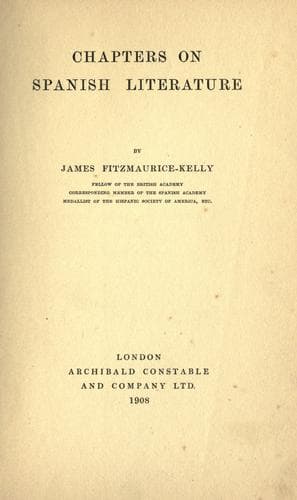
Chapters on Spanish LiteratureFitzmaurice-Kelly, James
History
Chapters on Spanish Literature
Fitzmaurice-Kelly, James
Spanish literature; Spanish literature -- History and criticism
These moralisings are the unessential and disfiguring element in Fernán
Caballero’s unconscious art. It is something to be able to tell a
story with intelligence and point, and this she does constantly. And,
besides the power of narration, she has the characteristic Spanish
faculty of undimmed sight. When she limits herself to what she has
actually seen (and, to be just, her expeditions afield are rare),
she is always alert, always attractive by virtue of her delicate,
feminine perception. Many phases of life are unknown to her; from other
phases she deliberately turns away; hence her picture is necessarily
incomplete. But she sympathises with what she knows, and the figures
on her narrow stage are rendered with dainty adroitness. There is no
great variety in her tableau of that mild Human Comedy which, with its
frugal joys and meek sorrows, it was her office to describe; but it
has the note of sincerity. Her methods are as realistic as those used
in later romances professing to be based on ‘human documents’—a phrase
now worn threadbare, but not yet invented when she began to write. She
reverted by instinct to realism of the national type,—realism which was
fully developed centuries before the French variety was dreamed of,—and
it was in the realistic field that her successors won triumphs greater
than her own.
Some ten or twelve years after the appearance of _La Gaviota_, Antonio
de Trueba leapt into popularity with a succession of stories all of
which might have been called—as one volume was called—_Cuentos de
color de rosa_. In the past my inability to appreciate Trueba as he
is appreciated in his native province of Vizcaya has brought me into
trouble. Each of us has his limitations, and, fresh from reading
Trueba once more, I stand before you impenitent, persuaded that, if
he flickers up into infantile prettiness, he sputters out in insipid
optimism. We cannot all be Biscayans, and must take the consequences.
In the circumstances I do not propose to deal with Trueba,—who, like
the rest of us, appears to have had a tolerably good conceit of
himself,—nor to spend much time in discussing the more brilliant Pedro
Antonio de Alarcón. Alarcón seems likely to be remembered better by _El
Sombrero de tres picos_—a lively expansion in prose of a well-known
_romance_—than by any of his later books. All literatures have their
disappointing personalities: men who at the outset seemed capable of
doing anything, who insist on doing everything, and who end by doing
next to nothing. Nobody who knows the meaning of words would say that
the author of _El Sombrero de tres picos_ did next to nothing, but much
more was expected of him. Whether there was, or was not, any reasonable
ground for these high hopes is another question. The ‘Might-Have-Been’
is always vanity. Save in such rare cases as that of Cervantes, who
published the First Part of _Don Quixote_ when he was fifty-eight (the
age at which Alarcón died in 1891), imaginative writers have generally
Public-domain text, read in full here on John Shaqi.
Reviews
Reviews
No reviews yet
Be the first to share your thoughts on this work.
Elsewhere in the archive
Join the Discussion
Join the discussion
Sign in to leave a comment or review.
Sign InorCreate an account