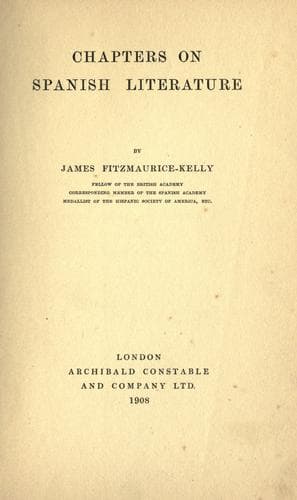
Chapters on Spanish LiteratureFitzmaurice-Kelly, James
History
Chapters on Spanish Literature
Fitzmaurice-Kelly, James
Spanish literature; Spanish literature -- History and criticism
It is a striking volume, but the distinguishing traits of _Bocetos al
temple_ are precisely those which characterise _Escenas montañesas_.
Pereda has developed in the sense that his touch is more confident, but
his point of view is the same as before. Take, for example, _La Mujer
del César_, the first story in the book: the moral simply is that it
is not enough to be beyond reproach, but that one must also seem to be
so. You may call this trite or old-fashioned in its simplicity, but it
is not ‘provincial.’ What is true is that the atmosphere of _Bocetos al
temple_ is ‘regional.’ The writer is not so childish as to suppose that
Madrid is peopled with demons, and the country hill-side with angels.
Pereda had no larger an acquaintance with angels than you or I have,
and his personages are pleasingly human in their blended strength and
weakness; but he had convinced himself that the constant virtues of the
antique world are hard to cultivate in overgrown centres of population,
and that the best of men is likely to suffer from the contagion of city
life. To this thesis he returned again and again: in _Pedro Sánchez_,
in _El Sabor de la Tierruca_, in _Peñas arriba_, he argues his point
with the pertinacity of conviction. There is nothing provincial in
the thesis, and it is good for those of us who are condemned to live
in fussy cities to know that we, too, seem as narrow-minded as any
fisherman or agricultural labourer. Can anything be more laughably
provincial than the Cockney, or the _boulevardier_, who conceives that
London, or New York, or Paris is the centre of the universe, that the
inhabitants of these places are foremost in the files of time? Nobody
is more provincial than an ordinary dweller in one of these large,
straggling, squalid villages. Pereda is not afflicted with megalomania;
he is not impressed by numbers; he does not ‘think in continents.’ He
believes all this to be the bounce of degenerate vulgarians, and leaves
us with a disquieting feeling that he may not be very far wrong.
Public-domain text, read in full here on John Shaqi.
Reviews
Reviews
No reviews yet
Be the first to share your thoughts on this work.
Elsewhere in the archive
Join the Discussion
Join the discussion
Sign in to leave a comment or review.
Sign InorCreate an account