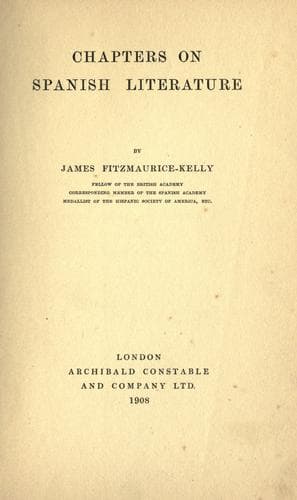
Chapters on Spanish LiteratureFitzmaurice-Kelly, James
History
Chapters on Spanish Literature
Fitzmaurice-Kelly, James
Spanish literature; Spanish literature -- History and criticism
He is not one of those who look forward to a new heaven and a new
earth next week. If you expect to find in him the qualities which you
find in Rousseau, or in any other wonder-child of the earthquake and
the tempest, you will assuredly be disappointed. But, if we take him
for what he is—a satirical observer of character, an artist whose
instantaneous presentation of character and of the visible world has
a singular relief and saliency—we shall be compelled to assign him
a very high place among the realists of Spain. No one who has once
met with the frivolous and vindictive Marquesa de Azulejo, with the
foppish Vizconde del Cierzo, with the futile Condesa de la Rocaverde,
or with Lucas Gómez, the purveyor of patchouli literature, can ever
forget them. In this particular of making his secondary figures
memorable, Pereda somewhat resembles Dickens, and both use—perhaps
abuse—caricature as a weapon. But the element of caricature is more
riotous in Dickens than in Pereda, and the acumen in Pereda is more
contemptuous than in Dickens. Pereda is in Spanish literature what
Narváez was in Spanish politics: he ‘uses the stick, and hits hard.’
Cervantes sees through and through you, notes every silly foible,
and yet loves you as though you were the most perfect of mortals,
and he the dullest fellow in the world. Pereda has something of
Cervantes’s seriousness without his constant amenity. He is nearer to
Quevedo’s intolerant spirit. Exasperated by absurdity and pretence,
he reverses the apostolic precept: so far from suffering fools
gladly, he gladly makes fools suffer. The collection entitled _Tipos
trashumantes_ contains admirable examples of his dexterity in malicious
portraiture—the political quack in _El Excelentísimo Señor_ who, like
the rest of us Spaniards (says Pereda dryly), is able to do anything
and everything; the scrofulous barber in _Un Artista_, whose father was
killed in the _opéra-comique_ revolution of ’54, who condescends to
visit Santander professionally in the summer, and familiarly refers to
Pérez Galdós by his Christian name; the hopeless booby in _Un Sabio_,
who has addled his poor brain by drinking German philosophy badly
corked by Sanz del Río, and who abandons the belief in which he was
brought up for spiritualistic antics which enable him to commune with
the departed souls of Confucius and Sancho Panza. These performances
are models of cruel irony.
Public-domain text, read in full here on John Shaqi.
Reviews
Reviews
No reviews yet
Be the first to share your thoughts on this work.
Elsewhere in the archive
Join the Discussion
Join the discussion
Sign in to leave a comment or review.
Sign InorCreate an account