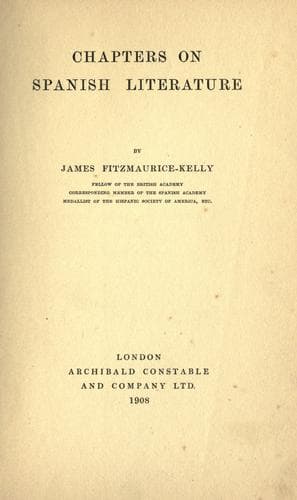
Chapters on Spanish LiteratureFitzmaurice-Kelly, James
History
Chapters on Spanish Literature
Fitzmaurice-Kelly, James
Spanish literature; Spanish literature -- History and criticism
Something of this polemical strain runs through all his romances, and,
after the fall of the republic and the restoration of the Bourbons,
his conservatism may have contributed to make him popular in the late
seventies and the early eighties. But we are twenty or thirty years
removed from the passions of that period, and Pereda’s work stands the
crucial test of time. He is not specially skilful in construction,
and digresses into irrelevant episodes; but he can usually tell his
tale forcibly, and, when he warms to it, with grim conciseness; he is
seldom declamatory, is a master of diction untainted by gallicisms, and
records with caustic humour every relevant detail in whatever passes
before his eyes. He is the chronicler of a Spain, reactionary and
picturesque, which is fast disappearing, and will soon have vanished
altogether. If the generations of the future feel any curiosity as to
a social system which has passed away, they will turn to Pereda for a
description of it just before its dissolution. He paints it with the
desperate force of one who feels that he is on the losing side. His
interpretation may be—it very often is—imperfect and savagely unjust;
but its vigour is imposing, and, if his world contains rather too many
degraded types, it is also rich in noble figures like Don Román Pérez
de la Llosía in _Don Gonzalo González de la Gonzalera_, and in profiles
of humble illiterates who, in the eyes of their artistic creator, did
more real service to their country than many far better known to fame.
Public-domain text, read in full here on John Shaqi.
Reviews
Reviews
No reviews yet
Be the first to share your thoughts on this work.
Elsewhere in the archive
Join the Discussion
Join the discussion
Sign in to leave a comment or review.
Sign InorCreate an account