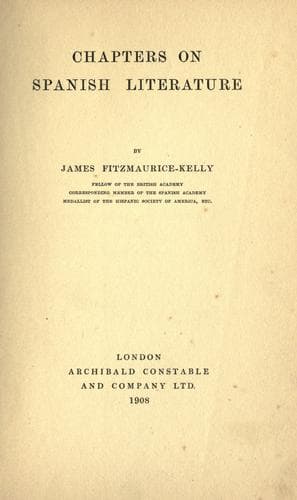
Chapters on Spanish LiteratureFitzmaurice-Kelly, James
History
Chapters on Spanish Literature
Fitzmaurice-Kelly, James
Spanish literature; Spanish literature -- History and criticism
In this frame of mind, habitual with him, he sat down to write _Pepita
Jiménez_. The story is the simplest imaginable. Pepita, a young widow,
is on the point of marrying Don Pedro de Vargas, when she meets
his son Luis, a young seminarist with exaggerated ideas of his own
spiritual gifts. Luis is a complete clerical prig, who disdains such
everyday work as preaching the gospel in his own country, and vapours
about being martyred by pagans. As he has not a vestige of religious
vocation, the end is easily foretold. At some cost to her own character
Pepita pricks the bubble, and all the young man’s aspirations melt into
the air; he is made to perceive that his pretensions to sanctity are
silly, marries the heroine who was to have been his stepmother, and
subsides into a worthy, commonplace husband. In his _Religio Poetae_
Patmore praises _Pepita Jiménez_ as an example of ‘that complete
synthesis of gravity of matter and gaiety of manner which is the
glittering crown of art, and which, out of Spanish literature, is to
be found only in Shakespeare, and even in him in a far less obvious
degree.’ Patmore has almost always something striking to say, and even
his critical paradoxes are interesting. We have no means of knowing how
far his Spanish studies went, but we may guess that his acquaintance
with Spanish literature was perhaps not very wide, and not very deep.
As regards Pepita Jiménez his verdict is conspicuously right: it is
conspicuously wrong with respect to Spanish literature as a whole. The
perfect blending of which he speaks is as rare in Spain as elsewhere.
In Valera it is the result of deliberate artistic method; his gravity
is a necessity of the situation; his gaiety is rooted in his sceptical
politeness. In his critical work his politeness is decidedly overdone;
he praises and lauds in terms which would seem excessive if applied to
Dante or Milton. He knows the stuff of which most authors are made,
presumes on their proverbial vanity, and flatters so violently that he
oversteps the limits of good-breeding. Some of you may remember the
dignified rebuke of these tactics by Sr. Cuervo. But in his novels
Valera strikes no attitude of impertinent or sublime condescension. He
analyses his characters with a subtle and admirably patient delicacy.
Public-domain text, read in full here on John Shaqi.
Reviews
Reviews
No reviews yet
Be the first to share your thoughts on this work.
Elsewhere in the archive
Join the Discussion
Join the discussion
Sign in to leave a comment or review.
Sign InorCreate an account