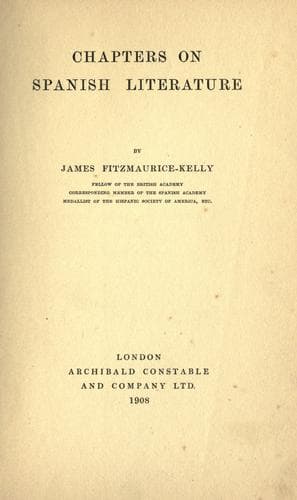
Chapters on Spanish LiteratureFitzmaurice-Kelly, James
History
Chapters on Spanish Literature
Fitzmaurice-Kelly, James
Spanish literature; Spanish literature -- History and criticism
A hostile critic might perhaps urge that Valera’s novels are too much
alike; that Doña Luz is cast in the same mould as Pepita Jiménez,
that Enrique is a double of Luis, and so forth. There is some truth
in this. Valera does repeat the situations which interest him most,
but so does every novelist; his treatment differs in each case, and
is logically consistent with each character. There is more force in
the objection that he overcharges his books with episodical arabesques
which, though masterly _tours de force_, retard the development of
the story. Now that we have them, we should be sorry to lose the
brilliant passages in which the quintessence of the great Spanish
mystics is distilled; but it is plainly an error of judgment to assign
them to Pepita. However, this objection applies less to _Doña Luz_
than to _Pepita Jiménez_, and it applies not at all to _El Comendador
Mendoza_—doubtless a transfigured piece of autobiography, both poignant
and gracious in its evocation of a far-off passion. And in his shorter
stories Valera often attains a magical effect of disquieting irony.
Most authors write far too much, either from necessity or from vanity,
and Valera, who was too acute to be vain, wasted his energies in too
many directions and on too many subjects. Still he has improvised
comparatively little in the shape of fiction, and, even in extreme old
age, when the calamity of blindness had overtaken him, he surprised and
enchanted his admirers with more than one arresting volume. Speaking
broadly, the characteristics of the best Spanish art are force and
truth, and in these respects Valera holds his own. Yet he is more
complicated and elaborate than Spaniards are wont to be. His work is
penetrated with subtleties and reticences; his force is scrupulously
measured, and his truth is conveyed by implication and innuendo,
never by emphasis nor crude insistency. Compared with his exquisite
adjustment of word to thought, the methods of other writers seem coarse
and brutal. You may refuse to recognise him as a great novelist, if you
choose; but it is impossible to deny that he was a consummate literary
artist.
Public-domain text, read in full here on John Shaqi.
Reviews
Reviews
No reviews yet
Be the first to share your thoughts on this work.
Elsewhere in the archive
Join the Discussion
Join the discussion
Sign in to leave a comment or review.
Sign InorCreate an account