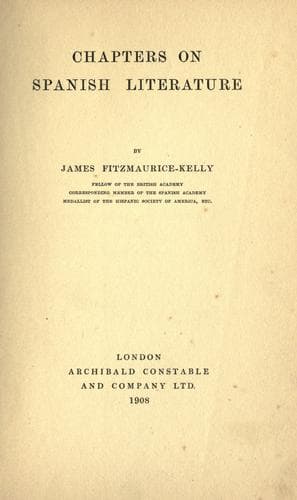
Chapters on Spanish LiteratureFitzmaurice-Kelly, James
History
Chapters on Spanish Literature
Fitzmaurice-Kelly, James
Spanish literature; Spanish literature -- History and criticism
If there had been, we may feel sure that Pérez Galdós would have hit
upon it, for his acumen and perseverance are undoubted. Not one of the
_Episodios Nacionales_ is a great book, but also not one is wanting
in great literary qualities—the faculty of historical reconstruction,
the evaluation of the personal factor in great events, and the gift of
picturesque detail. If the power of concentration were added to his
profuse equipment, Pérez Galdós would be an admirable master. Even as
it is, to any one who wishes to obtain—and in the most agreeable way—a
just idea of the political and social evolution of Spain from the time
of Charles IV. to the time of the Republic, the _Episodios Nacionales_
may be heartily commended. And, in these crowded pages, some figures
stand out with remarkable saliency—as, for instance, the guerrilla
priest in _Carlos VI. en la Rápita_, a volume which shows the author to
be unwearied as he draws near the end of his long task, and as vivid
as ever in historical narrative. He is, moreover, an astute observer
of the present, far-seeing in _Fortunata y Jacinta_ and humoristic in
_El Doctor Centeno_. You perhaps remember the description of the cigar
which Felipe smoked, the account of the banquet presided over by the
solemn and amiable Don Florencio—Don Florencio with alarming eyebrows,
so thick and dark that they looked like strips of black velvet. These
peculiarities are hit off in Dickens’s best manner, and yet with a
certain neutral touch. Not that Pérez Galdós is habitually neutral:
he is an old-fashioned Liberal with a thesis to prove—the admirable
thesis that liberty is the best thing in the world. But this is not
an obviously Spanish idea. The modernity of Pérez Galdós is exotic in
Spain. He gives us an interesting view of Spanish society in all its
aspects. Still,—let us never forget it,—the picture is painted not by
a native, but by a colonial, hand. Born in the Canary Islands, Pérez
Galdós lives in Spain, but is not of it; he dwells a little apart from
the high road of its secular life. And this lends a peculiar value to
his presentation; for what it loses in force, it gains in objectivity.
Public-domain text, read in full here on John Shaqi.
Reviews
Reviews
No reviews yet
Be the first to share your thoughts on this work.
Elsewhere in the archive
Join the Discussion
Join the discussion
Sign in to leave a comment or review.
Sign InorCreate an account