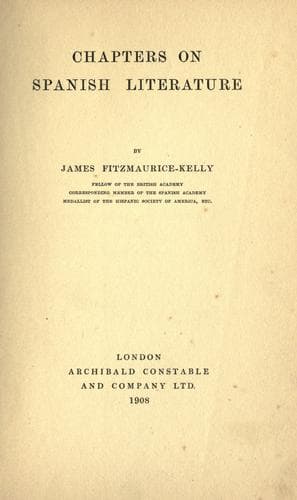
Chapters on Spanish LiteratureFitzmaurice-Kelly, James
History
Chapters on Spanish Literature
Fitzmaurice-Kelly, James
Spanish literature; Spanish literature -- History and criticism
The very name of his book, which has but recently become available in a
satisfactory form, has long been doubtful. About a century after it was
written, Alfonso Martínez de Toledo, the Archpriest of Talavera, called
it a _Tratado_; a few years later than the Archpriest of Talavera,
Santillana referred to it curtly as the _Libro del Arcipreste de Hita_;
Sánchez entitled it _Poesías_ when he issued it in 1790, and Florencio
Janer republished it in 1864 as the _Libro de Cantares_. But, as Wolf
pointed out in 1831,[3] Ruiz himself speaks of it as the _Libro de buen
amor_. However, we do not act with any indecent haste in these matters,
and it was not till just seventy years later that Wolf’s hint was taken
by M. Ducamin. We can at last read the _Libro de buen amor_ more or
less as Ruiz wrote it; or, rather, we can read the greater part of it,
for fragments are missing, some passages having been removed from the
manuscripts, perhaps by over-modest readers. Yet much remains to do. A
diplomatic edition is valuable, but it is only an instalment of what
we need. If any one amongst you is in search of a tough piece of work,
he can do no better for himself and us than by preparing a critical
edition of the _Libro de buen amor_ with a commentary and—above all—a
vocabulary.
The Archpriest of Hita was an original genius, but his originality
consists in his personal attitude towards life and in his handling
of old material. No literary genius, however great, can break
completely with the past, and the Archpriest underwent the influence
of his predecessors at home. It is the fashion nowadays to say that
he was not learned, and no doubt he poses at times as a simpering
provincial ignoramus, especially as regards ecclesiastical doctrine and
discipline:—
Escolar so mucho rrudo, njn maestro njn doctor,
aprendi e se poco para ser demostrador.
But the Archpriest does not wish to be taken at his word, and, to
prevent any possible misunderstanding, in almost the next breath he
slyly advises his befooled reader to consult the _Espéculo_ as well as
los libros de ostiense, que son grand parlatorio,
el jnocençio quarto, vn sotil consistorio,
el rrosario de guido, nouela e diratorio.
Public-domain text, read in full here on John Shaqi.
Reviews
Reviews
No reviews yet
Be the first to share your thoughts on this work.
Join the Discussion
Join the discussion
Sign in to leave a comment or review.
Sign InorCreate an account